Discover the homeland of Cyrus the Great, Darius, and Xerxes with a unique itinerary that brings together Iran's past and the contemporary...
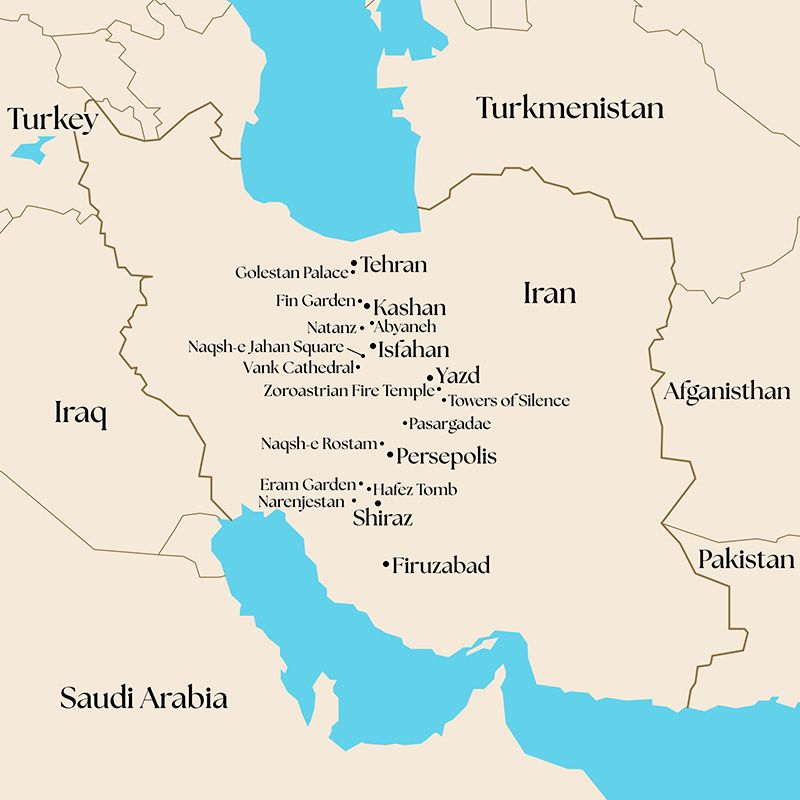
We cover the highlights of Tehran, Shiraz, Yazd, and Isfahan as we stroll through timeless streets and colorful bazaars, and mingle with hospitable and proud locals. The tour also includes ancient Persepolis, Persian gardens, and several other UNESCO-listed sights...
TOUR HIGHLIGHTS
- 13 days – tour starts in Shiraz and ends in Tehran
- People-to-people experiences, oriental bazaars, gardens
- UNESCO-listed sights: Friday Mosque of Isfahan & ancient Persepolis
- UNESCO-listed sights: Golestan Palace, Pasargadae, Eram Garden
- Vaults of the Central Bank for the Crown Jewels
- Mausoleum of Cyrus the Great
- Marvelous architecture of Isfahan, inspiration to 1001 stories
- Armenian Quarter and Vank Cathedral in Isfahan
- Zoroastrian Temple and Tower of Silence in Yazd
- Qashqai nomads, rural Abyaneh village
ITINERARY DETAILS
Day 01 – Saturday: Arrive in Shiraz
Participants will be provided with a transfer from the airport to the hotel upon arrival.
Start the day after a late breakfast. Our day is dedicated to stunning Shiraz, the city of poets, fine arts, roses, and the nightingale! We will visit Eram and Narenjestan Gardens—heavens on earth—and learn about and enjoy the 6,000-year-old Persian garden culture, which influenced gardens from Andalusia to India. The Eram Garden is listed by UNESCO, while the Narenjestan Garden is a meticulously kept property featuring a fine 19th-century Persian mansion.
Persia’s beloved poet Hafez is one of the very few poets whose mausoleum is honored as a pilgrimage destination. While visiting the lovely garden and mausoleum, we will recite his verses and join millions in appreciating his talent and inspiration. Nasir-ol-Mulk is a breathtaking kaleidoscope of fine Persian Islamic tiles. After appreciating the fine work in this mosque, we will move to the impressive Madrassah Khan, the theological school. Before calling it a day in the 11th-century oriental Vakil Bazaar, we will visit the Ali ibn Hamzeh Holy Shrine and admire the mirror decorations.
Sleep in Shiraz, 3 nights / Meals: B, L, D / Walking: Moderate / Bus: 2 hrs incl. transfer
Day 02 : Sunday: Visiting the Nomads
Shiraz and its surroundings are in the province of Fars, the birthplace of two ancient Iranian Zoroastrian dynasties, the Achaemenians, founded by Cyrus the Great, and the Sassanians. Today, we will visit generous and hospitable Qashqai nomads (pastoral nomads of Turkic origin) and witness their ancient lifestyle and traditions. We will return to Shiraz for the evening.
Meals: B, D / Walk: Moderate / Bus: 3 hrs
Day 03 : Monday: Firuzabad & Ardeshir-Khurra “Glory of Ardeshir”
In the morning, we will leave Shiraz for a short trip to Firuzabad (ancient Gur) to see the Ardeshir-Khurra “Glory of Ardeshir” palace, built by priest-king Ardeshir, the founder of the Sassanian dynasty.
Meals: B, L, D / Walk: Moderate / Bus: 3 hrs
Day 04 : Tuesday: Shiraz – Persepolis – Necropolis – Pasargadae – Yazd
After bidding farewell to Shiraz with a stop at the monumental Quran Gate, we will head to the ceremonial capital of the Achaemenid dynasty, Persepolis, a UNESCO site. Initiated by Darius I, Persepolis was the only major city of the ancient world built by free people. We will marvel at the reliefs and monuments of this eternal city and then move to the UNESCO-listed Naqsh-e Rostam, the monumental rock-carved necropolis of Achaemenid kings: Darius the Great, Darius II, Artaxerxes, and Xerxes. We will also see the Kaaba-ye Zartosht, the fire temple and sanctuary.
Later in the day, we will visit another UNESCO site, Pasargadae. It was the first capital of the Achaemenid Empire prior to Persepolis and was founded by Cyrus the Great in the 6th century BC. Among the ruins, we will see the tomb of Cyrus the Great himself. We will continue to Yazd, where we will sleep for 2 nights.
Sleep in Yazd, 2 nights / Meals: B, L, D / Walk: Moderate to strenuous / Bus: 5–6 hrs
Day 05 : Wednesday: Yazd
Yazd, a center of Zoroastrianism and a living museum, is one of the oldest cities in the world according to UNESCO. The isolated location of the city made it a shelter for Zoroastrians fleeing the Arabs, and for artists and poets fleeing the Mongols. Tucked between two deserts, Yazd is charming with its narrow streets and fine textiles.
Here, we will enjoy a guided city walk, see the highest “badgir” wind catcher (wind tower), the Azeri-style 12th-century Friday Mosque with the tallest entrance portal in Iran, and the Amir Chakhmaq Complex, one of the largest buildings in Iran. In the Old City, we will visit silk weaving workshops to see termeh brocades.
Meals: B, L, D / Walk: Moderate to strenuous / Bus: 1 hr
Day 06 : Thursday: Yazd to Isfahan
In the morning, we will continue exploring Yazd on foot. We will visit the Zoroastrian Fire Temple, where a sacred fire has been continuously burning since 470 AD and is now a Zoroastrian pilgrimage center. This is an opportunity to learn about Zoroastrianism, the ancient, pre-Islamic religion of Persia. It was founded by the Iranian prophet and reformer Zoroaster in the 6th century BC, and it shares many central concepts with the major world religions of Judaism, Christianity, and Islam.
Then, we will move on to the Towers of Silence, the burial place for Zoroastrians. Since Zoroastrians consider the dead body unclean, they place them on top of the Towers of Silence to be consumed by vultures, cleansed by the winds and the sun. In the afternoon, we will drive to Isfahan.
Sleep in Isfahan, 3 nights / Meals: B, L, D / Walk: Strenuous / Bus: 4–5 hrs
Day 07 : Friday: Isfahan
The 16th-century capital of Persia, Isfahan is well known for the Persian-Islamic architecture adorning the city and preserves much of its historic glory, with beautiful boulevards, covered bridges, palaces, mosques, and minarets. Hence it is known as “Esfahan nesf-e jahan ast,” a Persian proverb meaning “Isfahan is half of the world.”
During the two full days we will spend in Isfahan, we will discover its outstanding highlights. We will have an extensive visit to Naqsh-e Jahan Square, also known as Imam Square, the largest historical public square in the world after Tiananmen Square and a UNESCO World Heritage Site. It is surrounded by Safavid-period monuments, including Imam Mosque, Sheikh Lotfollah Mosque, Ali Qapu Palace, and the Qeisarieh “Isfahan” Bazaar, all of which we will visit.
In the afternoon, we will visit Si-o-Se Pol (Thirty-Three Bridge) and Khaju Bridge over the Zayandeh River, and drink tea and smoke water pipes in a traditional tea house.
Meals: B, L, D / Walk: Moderate / Bus: 1 hr
Day 08 : Saturday: Isfahan
In the morning, we will visit Chehel Sotun Palace, also known as the Forty Columns Palace, a reception and entertainment hall from the 17th century, marveling at the wall paintings, frescoes, miniatures, and ceramics of the interior. Last but not least, we will visit the Friday Mosque (Jameh Mosque), a UNESCO site and a stunning example of the evolution of mosque architecture spanning twelve centuries, from the 9th century onwards. It is the oldest monument of its kind in Iran and a prototype for later mosque designs throughout Central Asia.
Our afternoon is devoted to the discovery of New Julfa, the Armenian quarter in Iran, established in the early 17th century by Armenian immigrants from Julfa in Nakhichevan. Famous for their silk trade, these influential and well-connected people developed a business network from Europe to Asia. As a result, over the following centuries, New Julfa became the hub of one of the greatest trade networks of the modern era.
Today, the area remains one of the largest Armenian quarters in the world, with a school, sixteen churches, and the remarkable Surp Amenaprgitch Vank (Holy Saviour’s) Cathedral. The interior celebrates Armenian religious art with fine frescoes, gilded carvings, and rich tile work, depicting stories from the Old and New Testaments.
Meals: B, L, D / Walk: Moderate to strenuous / Bus: 1 hr
Day 09 : Sunday: Isfahan to Abyaneh
Our journey takes us to the historic red mud-brick village of Abyaneh in the rural countryside. En route, in Natanz, we will visit the Jameh Mosque and the adjoining mausoleum of the Sufi mystic Abd-as-Samad. In Abyaneh, we will walk through narrow streets and mingle with the colorfully dressed inhabitants.
Sleep in Abyaneh, 1 night / Meals: B, L, D / Walk: Moderate / Bus: 2 hrs
Day 10 : Monday: Abyaneh to Kashan
Today we head to Kashan, a large oasis whose pale desert tones contrast with the greenery of its well-tended gardens. In this city, known for its historic mansions, we will visit Fin Garden, wander through the mud-brick Kashan Bazaar, and visit the Tabatabaei Residence, a fine example of traditional architecture with wind towers, wall paintings, and stained glass.
Sleep in Kashan, 1 night / Meals: B, L, D / Walk: Easy / Bus: 2–3 hrs
Day 11 : Tuesday: Kashan to Tehran
As our journey in Iran draws to a close, we will drive to Tehran via the holy city of Qum. Arrival in Tehran and time to enjoy the capital.
Sleep in Tehran, 2 nights / Meals: B, L, D / Walk: Easy / Bus: 2 hrs
Day 12 : Wednesday: Tehran
Today we explore Tehran, the capital of Iran since the late 18th century. At the National Museum, we will visit both the Archaeological Museum (Museum of Ancient Iran), designed by French architect André Godard, and the Museum of the Islamic Era.
We will also visit the Central Bank vaults to admire the Imperial Crown Jewels of Persia, including the 182-carat Daria-i Noor diamond and the Pahlavi Crown. We continue to Golestan Palace, built over 400 years ago, and spend the remainder of the day in the Tehran Bazaar.
Meals: B, L, D / Walk: Easy / Bus: 2 hrs
Day 13 : Thursday: Good-bye
Tour ends after breakfast.
Meals: B
WHAT’S INCLUDED
- A certified SRM guide as tour leader
- Experienced bilingual (Farsi & English) certified guide throughout the tour
- Bus transportation for all tours and transfers in Iran
- All accommodations – best available in Iran
- All meals, with bottled water
- All admissions and tours for listed activities
- Tips for all services provided with the tour, including guide and driver
- Travel information and preparation package
NEED TO KNOW
- It is legal for US citizens to travel to Iran with a passport valid for at least 6 months at the time of their trip. The Swiss Embassy in Tehran protects US interests and provides consular services. Travelers with an Israel stamp may enter Iran after one year from the date of the stamp.
- SRM will apply for visas on behalf of travelers and obtain a reference number. Travelers must then contact the relevant embassy or consulate. In the USA, the Pakistan Embassy in Washington, DC represents Iran. Processing takes approximately 5–6 weeks.
- Iran is not any different from any other country in terms of laws. Violations such as theft, trespassing, or drug use are punishable. Alcohol is strictly prohibited.
- By law, women must dress modestly, covering arms and legs, and wear a headscarf in public.
- Food is varied and generally mild in spice. GMOs are not allowed.
- Currency is the Iranian rial; however, the toman is more commonly used (10 rials = 1 toman).
- Credit cards are uncommon; cash is recommended.
- Prohibited items include alcohol, narcotics, weapons, agricultural goods, drones, and transmission equipment.
- Work days are Saturday through Wednesday.
- The tour has an average physical level, with some uphill and downhill walking.
 Click to Enlarge