Turkey is the Biblical Holy Land of Asia Minor. It was the center stage where faith first flourished and spread. It provided both the earlier Jewish settlers and the later Christians a safer land to survive. Many Biblical (Old and New Testament) events took place in Asia Minor. Two-thirds of the twenty-seven books in the New Testament were either written to or from Asia Minor. The lack of awareness of this fact stems from the use of different names for the same place in different ancient and modern languages, Hittite, Lydian, Lycian, Persian, Greek, Roman, Byzantine, or Turkish.
Antioch, a city located in southern Turkey, was where the believers were first called Christians (Acts 11:26).
The three great apostles—Paul, Peter, and John— are linked with churches in Asia Minor, which is modern Turkey.
The Garden of Eden is believed to have been in Eastern Turkey, the Tigris and Euphrates have their headwaters in Turkey.
Abraham lived in Turkey (and perhaps was born here).
St. Paul was born and lived much of his life in Turkey.
St. John lived in Ephesus.
All seven Ecumenical Councils were held in Turkey.
Walking in the footsteps of early believers provides a rare chance to look into the roots of faith. Their path reflects deep devotion and lasting perseverance. Visiting these sites reveals the weight of their sacrifices and the commitment that shaped the early church.
Our immersive itinerary follows steps of St. Paul and opens doors of Biblical Turkey to travelers.
Tour Highlights
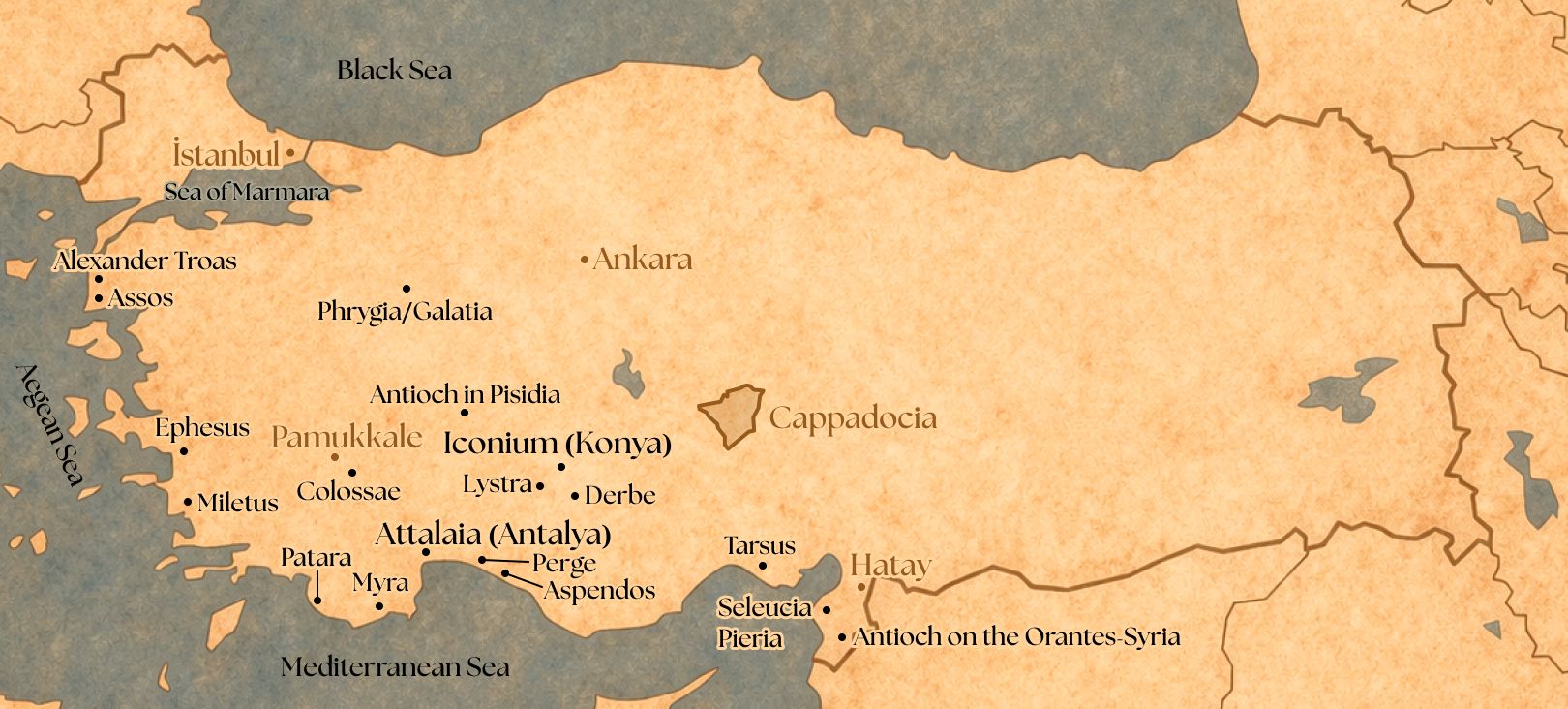
Major stops on St. Paul’s journeys
Attaleia
Perge / Perga
Patara beach
Laodicea
Hierapolis
Sardis
Philadelphia
Smyrna
Ephesus
Tour can be re-designed to your specifications, travel plans and expectations, expanded to include other regional tours, or further exploration of Turkey’s rich biblical heritage.
On the Steps of St. Paul
John of Patmos and Paul of Tarsus left a profound mark on the history of Christianity. Their time and works in Asia Minor defined Christianity as we know today. This itinerary focuses on their life and works, as well as covering other historic locations of prominence.
Itinerary Details
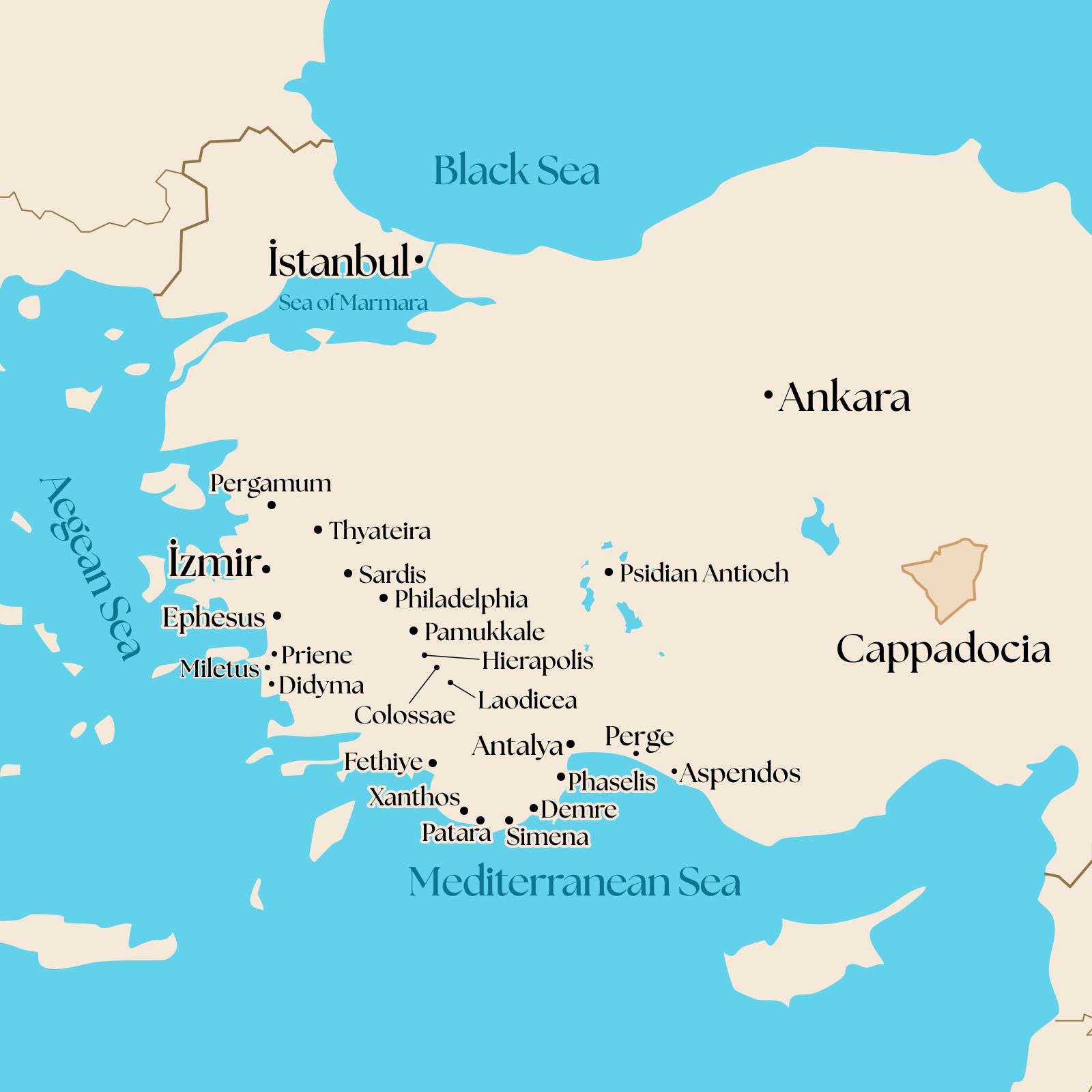
Day 1: Welcome to Antalya
We'll meet at 1 p.m, at the pleasant garden of our hotel located with the historic city walls of ancient Attaleia. After an introduction and orientation, you will stroll the streets of the Old Town and savor breathtaking views of the Taurus Mountains, which formed part of Paul’s journeys. You will take a break at the St. Paul Cultural Center located in a restored mansion, visit with the congregation and make local friends. Sleep in Antalya, 2 nights
Walking: 2-4 miles. Moderate on cobblestone streets with mild uphill/downhill.
Day 2: Perge and Aspendos
You will spend the day east of Antalya, visiting ancient Perge / Perga and Aspendos. The day will start with Perge / Perga - extensively excavated and well studied for time of Paul. It was visited by Paul, Barnabas, and John Mark (Acts 13:13-14) on their first journey. In Aspendos, you will see the one of the best preserved and most complete Roman theatres. Afternoon is yours to visit the award winning Archaeological Museum of Antalya, to rest in your hotel or to take a dip in the Meditearranean.
Walking: 2-4 miles. Moderate, on marble slabs in Perga.
Day 3: Psidian Antioch
The day starts with a scenic drive north to Psidian Antioch (Yalvaç), the Roman city that impressively sits at 1,236 meters (4,055 feet) in the foothills of the Sultandağı mountain range, a natural miliraty center at the junction of ancient roads. Once in Yalvaç, you will have the opportunity to walk the streets of ancient Psidian Antioch (Acts 13:14-52) and experience the same urban environment St. Paul encountered during all of his missionary journeys. At the city center, you will be near the synagogue where St. Paul delivered his sermon—not only to Jews but also to the Gentiles. This moment symbolizes the transition of Christianity from a Jewish sect to a universal faith open to all nations.
There will be a pleasant break under a 400-year-old oriental plane tree at the center of modern Yalvaç where you will have chance to mingle and chat with the locals.
Return to Antalya.
Walking: 2-3 miles. Moderate, unpaved grounds in Psidian Antioch.
Day 4: Phaselis, Demre/Myra, Simena
The day starts with a scenic drive westwards. First visit of the day will be to the idyllic Phaselis ancient city -mentioned in 1 Maccabees 15:23. You will see all the three harbors, the harbor street, ancient theatre and the aqueducts in a thick forest by the sea. In modern Demre -ancient Myra- you will visit the ancient harbor where Paul changed ships on his way to Rome (Acts 27:5–6). After a surprising visit to to the Church of St. Nicholas—Yes, St Nicholas, the inspiration for Santa Claus was indeed a native of the Mediterranean coastline—without a reindeer-pulled sleigh—have a pleasant trip in a glass bottomed boat to see the ruins of sunken Simena off the coast of Kekova island. Sleep in Kaş, 2 nights.
Walking: 2-4 miles. Moderate, unpaved ground in Phaselis.
Day 5: Patara and Xanthos
You will visit two Lycian cities this morning, Patara on the beach where Paul, Luke, and other travelers changed ships here at the end of their Third Missionary Journey according to the book of Acts (Acts 21:1–2). Then you will visit the ancient capital, Xanthos, famous for its legendary defense against the Persians in the 6th century BC -despite their bravery, the city fell to Persians, and Xanthians heroically chose death over slavery burning the city along with themselves!
Walking: 2-4 miles. Moderate, unpaved grounds in Patara and Xanthos.
Day 6: Colossae and Laodicea
Bidding farewell to the coastline, you will head north over the Taurus Mountains for Colossae, mentioned in the books of Colossians and Philemon. In nearby Laodicea, one of the Seven Churches of Revelation (3:14-22) you will witness the remnants of grand Roman economy, whose citizens were chastised for being lukewarm and not truly dedicated (3.14-22).
Time to enjoy the thermal pool built over Roman ruins. Sleep in Pamukkale, 1 night.
Walking: 2-4 miles. Moderate, unpaved grounds in Colossae and Laodicea.
Day 7: Hierapolis, Didyma, Miletus
In the morning, you will explore the ancient city of Hierapolis where Christianity was introduced by Epaphras (Colossians 4:12–13), a local of Collosae.
Paul wrote from prison: "Epaphras, who is one of you and a servant of Christ Jesus, sends greetings. He is always wrestling in prayer for you, that you may stand firm in all the will of God, mature and fully assured. I vouch for him that he is working hard for you and for those at Laodicea and Hierapolis."
— Colossians 4:12–13
You will see the theatre, agora, colonnaded street and the Martyron of St. Phillip who was a local in Hierapolis.
With a short detour, visit the Temple of Apollo in Didyma—the largest marble temple of the archaic period—approximately twice the size of Parthenon in Athens- and ancient Miletus where Paul bade farewell to the elders of the church at Ephesus at the end of his Third Missionary Journey (Acts 20). Sleep in Kuşadası, 2 nights.
Walking: 4 - 6 miles. Moderate to strenuous. Partially unpaved grounds in the ancient cities, uphill walk on dirt to Martyron of St. Phillip.
Day 8: Ephesus
The ancient city of Ephesus holds a remarkable place in biblical history. It was one of the seven cities of Revelation (1:11), home to St. Paul for almost three years and the site of the third Ecumenical Council. Your day is dedicated to discovering the ancient and biblical history of Ephesus and its surroundings. Your comprehensive tour in the ancient city includes Terrace Houses, Marble Street, Theatre, Harbor Street, the Agoras, the famous Library of Celsus, and all other significant public structures.
Your day will continue with visits to Basilica of St. John, the traditional site of the burial place of John, and the House of Virgin Mary.
Walking: 4 - 6 miles. Moderate to strenuous. Irregular marble slabs throughout Ephesus.
Day 9: Sardis, Philadelphia and Smyrna
On the way to ancient Smyrna, visit Sardis (3:1-6) and Philadelphia (3:7-22), both of which were among the Seven Churches of Revelation. Sardis was home of Lydian King Croesus who minted the first coin and inspired the term “as rich as Croesus”. Here you will visit the colossal synagogue, the gymnasium, ancient shopping arcade and the Temple of Artemis. Before the day concludes, visit the Roman Agora of Izmir (one of the Seven Churches of Revelation 2.8-11), home of those who were promised the crown of life as they remained faithful in spite of the persecution they suffered. Sleep in Izmir, 2 nights.
Walking: 2 - 4 miles. Moderate, unpaved grounds in Sardis.
Day 10: Pergamum and Thyatira
On the last day of your pilgrimage, you will visit two of the Seven Churches of Revelation, ancient Thyatira (Rev. 2:18-29) which was the original home of Lydia (Acts 16:11-5), and Acropolis of Pergamum where the throne of Satan resided. Before returning to Izmir, visit the Asclepion healing center in the lower valley that was part of ancient Pergamum.
Walking: 3 - 5 miles. Strenuous, unpaved grounds and steep uphill/downhill walks in Pergamum.
Day 11: Good-bye
Your tour ends after breakfast.
What’s included
A certified SRM guide
Private chauffeured vehicle
Tolls, bridges and parking
Accommodations in chosen hotels
Lunch
Admissions
Fast track
Contact us for questions, prices, booking and customization.
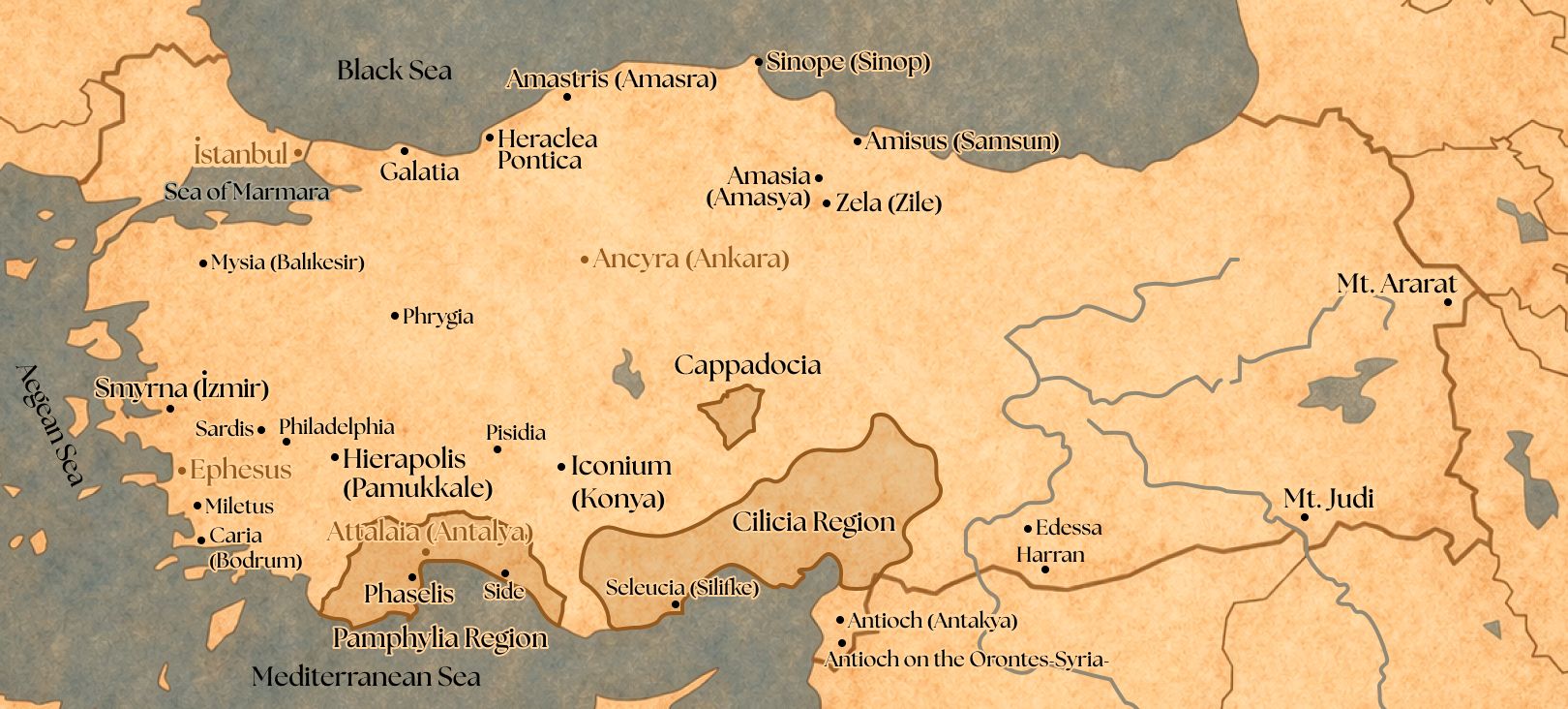
Visited by St. Paul
Only renowned locations; not an exhaustive map.
Only renowned locations; not an exhaustive map.
Visited by St. Paul
Tarsus
St. Paul’s birthplace (Acts 21:39)
Antioch on the Orantes-Syria (Antakya)
Base for missions for St. Paul’s firsy journey.
Start/end point for missionary journeys; significant preaching (Acts 13:1–3, 14:26).
Companied by SS Barnabas, Silas and others
Acts 6:5; 11:19-30; 15:3; 15:22-40; 18:22-23; Ignatius: Philadelphians 10.1; Smyrnaeans 11.1; Matyrdom of Polycarp 7.1
Antioch in Pisidia (Yalvaç, Isparta)
St. Paul visited during his first journey, and preached.
Synagogue sermon; many conversions (Acts 13:14–51; 14:19; 21-23)
Companied by St. Barnabas.
Iconium (Konya)
St. Paul visited during his first and second journeys, and preached.
Evangelism; faced persecution; strengthened believers (Acts 13:51; 14:1–7; 16:2)
Companied by Barnabas; later Silas
Lystra (Gökyurt, Hatunsaray, Meram, Konya)
St. Paul visited during his first and second journeys, healed and recruited.
Healed lame man; mistaken for gods; Timothy joined (Acts 14:6–23; 16:1–5)
Companied by Barnabas; later Silas and Timothy
Derbe (Ekinözü, Karaman)
St. Paul visited during his first and second journeys, and taught.
Made disciples; revisited to strengthen believers (Acts 14:6, 20–21; 16:1, 20:4)
Companied by Barnabas; later Silas and Timothy
Phrygia/Galatia (Eskişehir and the surrounding areas)
St. Paul visited during his second and third journeys, and strengthed faith.
Delivered Jerusalem council decrees; church encouragement (Acts 16:6; 18:23)
Companied by Silas, Timothy, Luke.
Alexander Troas (Dalyan, Ezine, Çanakkale)
St. Paul visited during his second and third journeys, had visions.
Vision of Macedonia; cloak left behind (Acts 16:8–10; 2 Tim 4:13)
Companied by Luke; later Tychicus
Assos (Behramkale)
St. Paul visited during his third journey.
It was on his walking route from Troas to meet ship at Assos. Acts 20:13-14
Companied by Luke; and other companions
Ephesus
St. Paul visited during his third journey, his long term ministry.
Stayed ~3 years; extensive preaching, miracles; riot (Acts 19), wrote 1 & 2 Corinthians; possibly Philippians.
Companied by Silas, Timothy, Luke.
Miletus
St. Paul visited during the return from the third journey on the way to Jerusalem.
Paul was in a hurry to reach Jerusalem by Pentecost, so instead of stopping in Ephesus again, he called for the Ephesian elders to meet him in Miletus (Acts 20:18-38)
Paul’s emotional farewell speech is recorded, where he warned the Ephesian elders to be vigilant and faithful shepherds.
Companied by Silas, Timothy, Luke, and others.
Colossae (Honaz, Denizli)
The church by Epaphras, a convert from Paul's ministry in Ephesus. Colossians 1:7–8
Paul addresses the Colossian believers indirectly, wrote Colossians from Roman imprisonment.
Letter delivered by Onesimus and,- Tychicus.
Perga (Perge)
St. Paul visited during his first journeys, and preached.
Landed here after leaving Cyprus; John Mark left the mission.
It served as a transit and preaching point. Acts 13:13–14; 14:25
Companied by Barnabas and John Mark.
Myra (Demre)
Returning to Rome from Caesarea (Acts 27:5–6).
Paul changed ships here on the voyage toward Rome
Companied by Luke, other travelers aboard his ship.
Patara
St. Paul visited during end of his third journeys.
Paul, Luke, and others sailed from here to Syrai for Jerusalem. Acts 21:1–2
Companied by Luke and other disciples.
Attalaia (Antalya)
St. Paul’s departure point from Pamphylia at the end of the first journey. Acts 14:25-26
From here sailed back to Antioch. Acts 14:25-26
Companied by Barnabas.
Seleucia Pieria (Selefkiye, Çevlik)
St. Paul visited during at the beginnig of his first journey. Paul and Barnabas set sail with John Mark to Cyprus. Acts 13:4
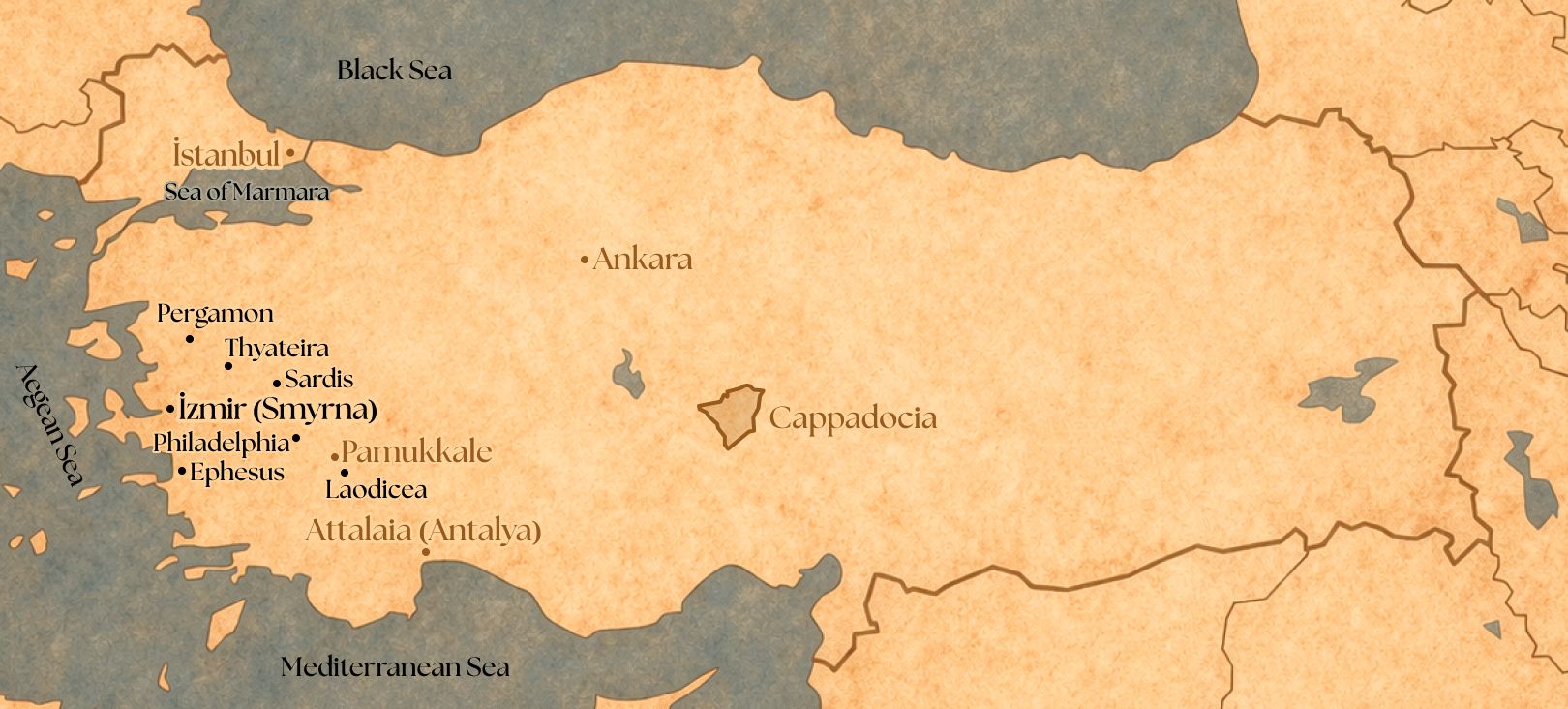
7 Churches of Revelation
Only renowned locations; not an exhaustive map.
Only renowned locations; not an exhaustive map.
7 Churches of Revelation
Ephesus
One of the Churches of Revelation. Revelation 2:1-7
Praised for its hard work and perseverance but warned to repent and return to its initial zeal.
Smyrna
One of the Churches of Revelation. Revelation 2:8-11
Suffered persecution and poverty yet spiritually rich, encouraged to remain faithful even to the point of death, promised the crown of life.
Pergamum
One of the Churches of Revelation. Revelation 2:12-17
Location of "Satan's throne", commended for steadfast faith but criticized for tolerating false teachings, urged to repent.
Thyatira (Akhisar, Manisa)
One of the Churches of Revelation. Revelation 2:18-29
Praised for love, service, faith, and patience but sharply rebuked for tolerating the false prophetess "Jezebel," urged strongly to repent.
Original home of Lydia (Acts 16:11-5).
Sardis
One of the Churches of Revelation. Revelation 3:1-6
Reputed to be alive but spiritually dead, urgently called to wake up, repent, and strengthen what remains.
Philadelphia (Alaşehir, Manisa)
One of the Churches of Revelation. Revelation 3:7-22
Faithful church, praised for endurance despite little strength, promised protection and an open door no one can shut.
Laodicea
One of the Churches of Revelation. Revelation 3:14-22
The lukewarm church, neither cold nor hot, warned strongly against spiritual complacency, urged to repent and open the door to Christ.
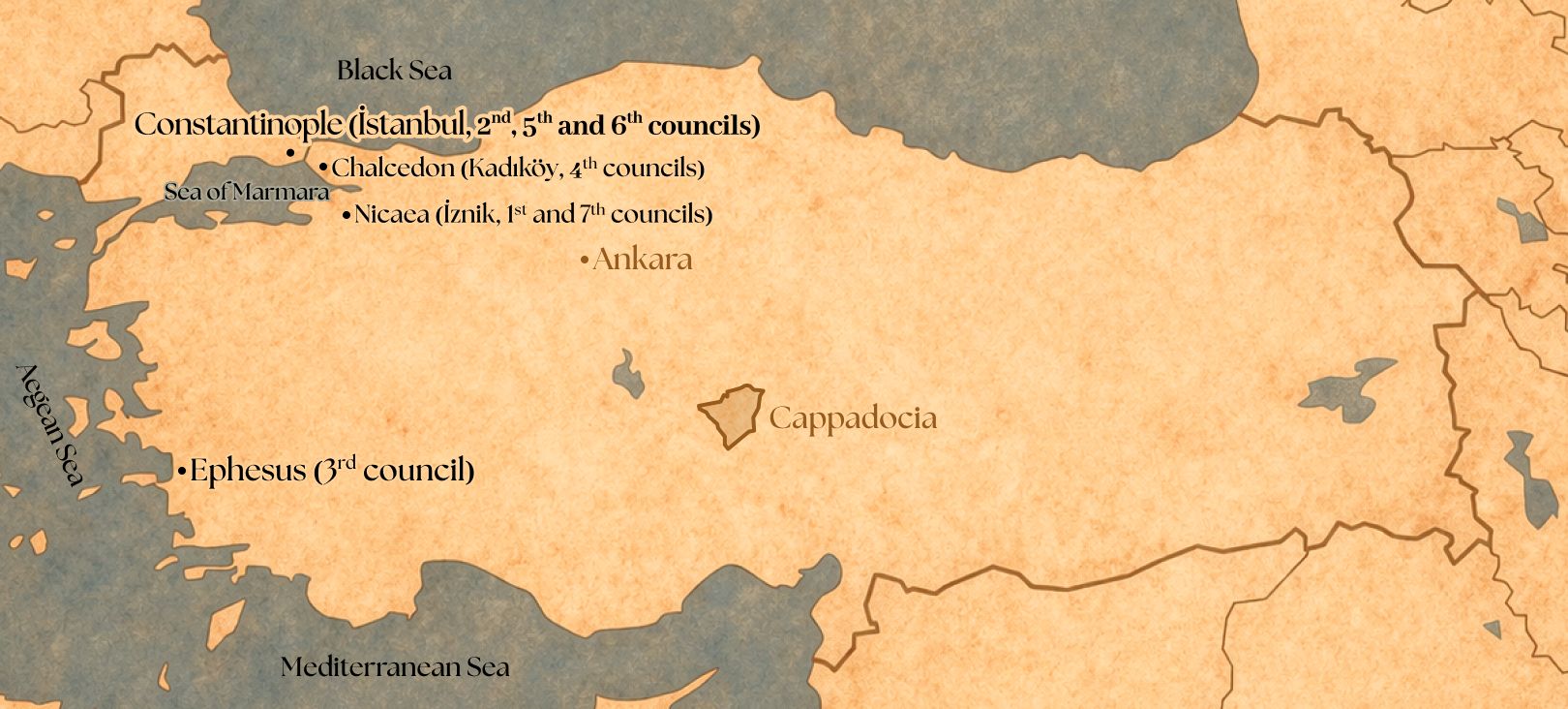
Ecumenical Councils
Only renowned locations; not an exhaustive map.
Only renowned locations; not an exhaustive map.
Ecumenical Councils
NICAEA (İZNİK)
1st Council: First Council of Nicaea (325 AD)
May–August 325
Formulation of the Nicene Creed, affirming the divinity of Jesus Christ, asserting He is of the same essence (homoousios) as the Father.
Condemnation of Arianism, a teaching claiming that Christ was created and not divine.
Established the uniform observance of the date of Easter.
Established foundational Christological doctrine, affirming Christ's divinity, shaping mainstream Christian theology.
7th Council: Second Council of Nicaea (787 AD)
September–October 787
Restoration and justification of the veneration of icons (images), ending the period of Iconoclasm (the rejection and destruction of religious images).
Differentiation between veneration (dulia) of images and worship (latreia), reserved for God alone.
Shaped Eastern Orthodox and Catholic practice, embedding icons firmly in liturgical and devotional life.
CONSTANTINOPLE (ISTANBUL)
2nd Council: First Council of Constantinople (381 AD)
May–July 381
Expansion and reaffirmation of the Nicene Creed (Niceno-Constantinopolitan Creed), clearly defining the divinity of the Holy Spirit.
Condemned Macedonianism (denial of the Holy Spirit’s divinity) and Apollinarianism (denial of Christ’s full humanity).
Finalized the doctrine of the Trinity as core Christian belief.
5th Council: Second Council of Constantinople (553 AD)
May – June 553
Further condemned Nestorian teachings, specifically the writings known as the "Three Chapters."
Attempted to reconcile divisions arising after Chalcedon, reinforced Christological definitions from previous councils.
6th Council: Third Council of Constantinople (680–681 AD)
November 680–September 681
Condemned Monothelitism, a teaching stating Christ had only one will (divine), affirming instead that Christ possessed both a human and divine will (Dyothelitism).
Clarified and reinforced Chalcedonian Christology, ensuring acceptance of Christ’s full humanity, including a human will.
CHALCEDON (KADIKÖY)
4th Council: Council of Chalcedon
October–November 451
Declaration of Christ’s dual nature as fully human and fully divine (hypostatic union) without confusion, separation, or division.
Condemnation of Monophysitism (the belief Christ had only one divine nature).
Established the Chalcedonian definition, a cornerstone of Christology, influential in Roman Catholic, Orthodox, and Protestant theology.
EPHESUS
3rd Council: Council of Ephesus (431 AD)
June–July 431
Confirmed Mary’s title as Theotokos (God-bearer), affirming the unity of Christ’s divine and human nature.
Condemnation of Nestorianism, the belief that Christ was two separate persons (human and divine) loosely joined.
Strengthened Marian devotion; cemented the unity of Christ’s personhood, shaping Orthodox and Catholic Mariology.
Old Testament
Only renowned locations; not an exhaustive map.
Only renowned locations; not an exhaustive map.
Old Testament
Mount Ararat is widely considered the resting place of the Ark. Genesis 8:4; Tobit 1:21; 2 Kings 19:37; Isiah 37:38; Jeremiah 51:27
Mount Judi in Şırnak Province, an alternative traditional resting place for Noah’s Ark, per Syriac/Armenian early church writers and Qur’anic text. Ancient name was Mt. Masius. Genesis 8:4; Tobit 1:21
Harran: The city where Terah, Abraham’s father, lived and from where Abraham was called by God (Genesis 11:31–12:5). Harran is identified with the biblical “Ur of the Chaldeans.”
Edessa (Şanlıurfa): the birthplace of Abraham, linked in legends to Nimrod and Abraham’s fiery ordeal near Pool of the Sacred Carp.
Carchemish (Karkamış): A key strategic fortress in Mesopotamia, later within Assyrian/Neo-Babylonian theaters of war.
2 Chronicles 35:20 – Pharaoh Neco and Josiah clash at Carchemish.
Jeremiah 46:2 – Egypt vs. Babylon at Carchemish.
Isaiah 10:9 – Used to illustrate Assyrian might
Esdras 1:15
Cappadocia
Mentioned in prophetic genealogy of Japheth’s descendants in Genesis 10:1–5 and again in 1 Peter 1:1.
While not in Old Testament narrative, it is origin-cited lineage related to the “mountains of Ararat”
Lawazantiya (Tatarli, Adana Province)
A Hurrian/Hittite cult‐center city, major in Bronze Age Anatolia—mentioned in Hittite records, not biblical text, but often included in biblical‐land lists
Tigris and Euphrates Rivers (Dicle and Fırat)
Tigris and Ephrates have their headwaters in Turkey. Upper Mesopotamia -literally land between the rivers- and tip of the Fertile Crescent is southeast Turkey.
Genesis 2:14, 15:18; Exodus 23:31; Deuteronomy; Daniel 10:4; Joshua 1:4; Samuel 8:3; 2 Kings 23:29; 24:7; 1 Chronicles 5:9; 18:3; 2 Chronicles 35:20; Jeremiah 13:4-7; 46:2, 6, 10; Tobit 6:2; Judith 1:6, 2:24; Sirach 24:26; 1 Maccabes 3.32, 37; 1 Esdras 1:25, 27; 2 (4) Esdras 13:43.
Revelation 9.14; 16:12
Togarmah (Gürün, Tohma Basin, Sivas)
Strategic location, key city connecting three regions and Tohma Basin.
Genesis 10:3; 1 Chronicles 1:6, Ezekiel 27:14, 38:6
Aram-naharaim (Somewhere between Kilis and Suruç)
Ancesterial home of Abraham.
Abraham’s servant went to Aram-hanaraim to find a wife for Isaac.
Genesis 24:10; Deutronomy 23:4; Judges 3:8, 10; Numbers 23:7; 1 Chronicles 19:6; Psalm 60:1
Eden (Somewhere between Harran and Habur)
Someplace in Mesopotamia, since mentioned along with Gozan and Haran, probably close to them.
Genesis 2:8, 10, 15; 3:23-24; 4:16, 11:31, 32; 12:4, 5; 27:43; 28:10; 29:4; 2 Kings 19:12; Isaiah 37:12; 51:3, Ezekiel 27:23, 28:13, 31:9, 16, 18; 36:35; Joel 2:3; Amos 1:5
Acts 7:2, 4
Gozan (Habur)
Heavy punishment was inflicted on it when they rebelled in 759 BC.
2 Kings 17:6, 18:11; 19:12; 1 Chronicles 5:26, Isaiah 37:12
Edessa / Ur (Şanlıurfa)
Genesis 11:28, 31; 15:7; Nehemiah 9:7
Haran (Harran)
Someplace in Mesopotamia, since mentioned along with Gozan and Haran, probably close to them.
Genesis 11:31, 32; 12:4, 5; 27:43; 28:10; 29:4; 2 Kings 19:12; Isaiah 37:12; Ezekiel 27:23.
Acts 7:2, 4
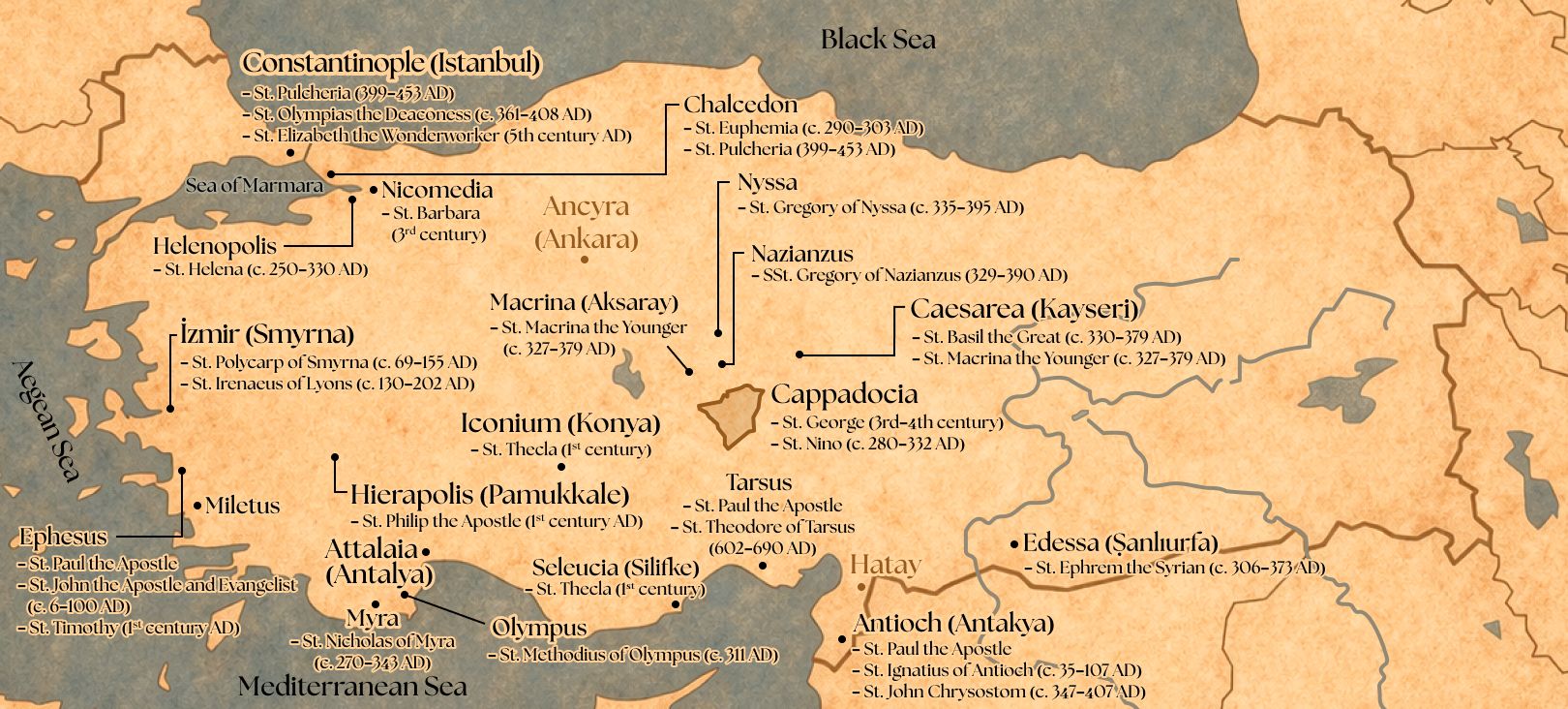
Tarsus, Antioch (Antakya), Ephesus
St. Paul the Apostle (c. 5–67 AD)
Born in Tarsus, lived in Antioch, Ephesus and several other places in Asia Minor.
Known for missionary journeys throughout Asia Minor and Greece; instrumental in spreading Christianity beyond Judaism, foundational theologian of the New Testament, author of several epistles.
Ephesus, Patmos
St. John the Apostle and Evangelist (c. 6–100 AD)
Credited with authoring the Gospel of John, three epistles, and the Book of Revelation. Central figure linking Apostolic Christianity and the Patristic era.
Smyrna (İzmir)
St. Polycarp of Smyrna (c. 69–155 AD)
Disciple of John the Apostle, early Church Father, bishop, martyr. His martyrdom inspired subsequent Christian martyr literature.
Antioch (Antakya)
St. Ignatius of Antioch (c. 35–107 AD)
Early Church Father, bishop of Antioch, martyr under Trajan. His epistles significantly shaped early Christian theology and ecclesiology.
Myra (Demre)
St. Nicholas of Myra (c. 270–343 AD)
Beloved bishop famous for generosity and compassion; inspiration for modern Santa Claus figure. Revered globally in both Eastern and Western churches.
Caesarea (Kayseri)
St. Basil the Great (c. 330–379 AD)
Importance: Cappadocian Father, bishop, theologian, founder of monasticism in the East, key figure defending orthodoxy against Arianism.
Nyssa (Harmadalı, Ortaköy, Aksaray)
St. Gregory of Nyssa (c. 335–395 AD)
Cappadocian Father, influential theologian-philosopher, major contributor to Christian mysticism and theological anthropology.
Nazianzus (Bekarlar, Gülağaç, Aksaray)
St. Gregory of Nazianzus (329–390 AD)
Cappadocian Father, influential theologian known as "Gregory the Theologian," critical defender and formulator of Trinitarian doctrine. Presided briefly over the Council of Constantinople (381).
Caesarea (Kayseri), Annesi (Aksaray)
St. Macrina the Younger (c. 327–379 AD)
Sister of St. Basil the Great and St. Gregory of Nyssa; influential spiritual and theological mentor to both.
Renowned for her deep spirituality, asceticism, theological intellect, and her establishment of one of the earliest monastic communities for women.
Her profound spiritual dialogue with Gregory of Nyssa (documented in Life of Macrina) significantly shaped his theological outlook, particularly regarding resurrection, soul, and the ascetic ideal.
Recognized globally as a key figure representing female leadership and theological influence in early Christianity.
Macrina’s theological contributions, especially through her brothers' writings, profoundly impacted Christian theology. She represents early Christian ascetic ideals and the significant yet often underrecognized role of women in the early church.
Antioch (Antakya), Constantinople (İstanbul)
St. John Chrysostom (c. 347–407 AD)
Renowned preacher ("Golden Mouth"), Archbishop of Constantinople, influential homilist, Church Father, known for sermons emphasizing social justice, liturgical contributions.
Edessa (Şanlıurfa)
St. Ephrem the Syrian (c. 306–373 AD)
Celebrated as theologian-poet, author of extensive theological hymns, influential in Eastern Christianity’s hymnography and theological expression.
Smyrna (İzmir)
St. Irenaeus of Lyons (c. 130–202 AD)
Born and early life in today’s modern İzmir. Bishop of Lyon (Gaul), key theologian refuting Gnosticism, bridging Eastern (Asia Minor) and Western traditions.
Tarsus
St. Theodore of Tarsus (602–690 AD)
Became Archbishop of Canterbury in England; reorganized English Church, introduced Greek and Latin scholarship, significantly shaped medieval Christianity in Britain.
Olympus (Olimpos, Antalya)
St. Methodius of Olympus (d. c. 311 AD)
Early martyr, Church Father, theologian, authored influential anti-heretical works, particularly against Origenism.
Nicomedia (İzmit)
St. Barbara (3rd century)
Revered martyr, globally recognized in both Eastern Orthodoxy and Catholicism, patroness of artillerymen and miners, symbol of resilience and bravery.
Cappadocia
St. George (3rd–4th century)
Widely venerated martyr and warrior-saint, recognized globally as patron saint of numerous nations (e.g., England, Georgia). His legend inspired courage, protection, and spiritual warfare.
Helenopolis (Hersek, Yalova)
St. Helena (c. 250–330 AD)
Mother of Constantine the Great; known for discovering the True Cross in Jerusalem, influential in spreading Christianity through the empire.
Ephesus
St. Timothy (1st century AD)
Companion and disciple of Apostle Paul, traditionally first bishop of Ephesus, significant leader in the early church structure.
Hierapolis (Pamukkale)
St. Philip the Apostle (1st century AD)
One of the Twelve Apostles, preached Christianity in Asia Minor, lived and martyred in Hierapolis. Important figure for missionary activity in Anatolia.
Iconium (Konya), Seleucia (Silifke)
St. Thecla (1st century)
Disciple of St. Paul, widely celebrated as a proto-feminist Christian figure. Her story, "Acts of Paul and Thecla," was extremely popular in early Christian communities.
Cappadocia
St. Nino (c. 280–332 AD)
Importance:
"Enlightener of Georgia," credited with converting the Kingdom of Iberia (modern-day Georgia) to Christianity.
Chalcedon (Kadıköy)
3St. Euphemia (c. 290–303 AD)
Famous martyr recognized in Eastern and Western churches. Played an indirect yet symbolic role during the Council of Chalcedon (451 AD), reportedly aiding the decision against Monophysitism through a miracle involving her relics. Her tomb in Chalcedon was a significant pilgrimage site.
Constantinople (Istanbul)
St. Pulcheria (399–453 AD)
Byzantine empress; influential politically and spiritually. Instrumental in organizing and hosting the Council of Chalcedon. Promoted Marian devotion, helping establish traditions around Mary’s divine motherhood and purity.
Canonized primarily in Eastern Orthodox Christianity but widely recognized historically for shaping Christological doctrine.
Constantinople (Istanbul)
St. Olympias the Deaconess (c. 361–408 AD)
Wealthy noblewoman who became a deaconess. Renowned philanthropist; financially supported St. John Chrysostom. Founded monastic communities and cared extensively for the poor and needy, significantly influencing Christian charity traditions.
Constantinople (Istanbul)
St. Elizabeth the Wonderworker (5th century AD)
Abbess and renowned ascetic figure in Byzantine Constantinople. Known for miracles, spiritual leadership, and profound devotion. Significantly influenced Byzantine monasticism, particularly female spirituality.
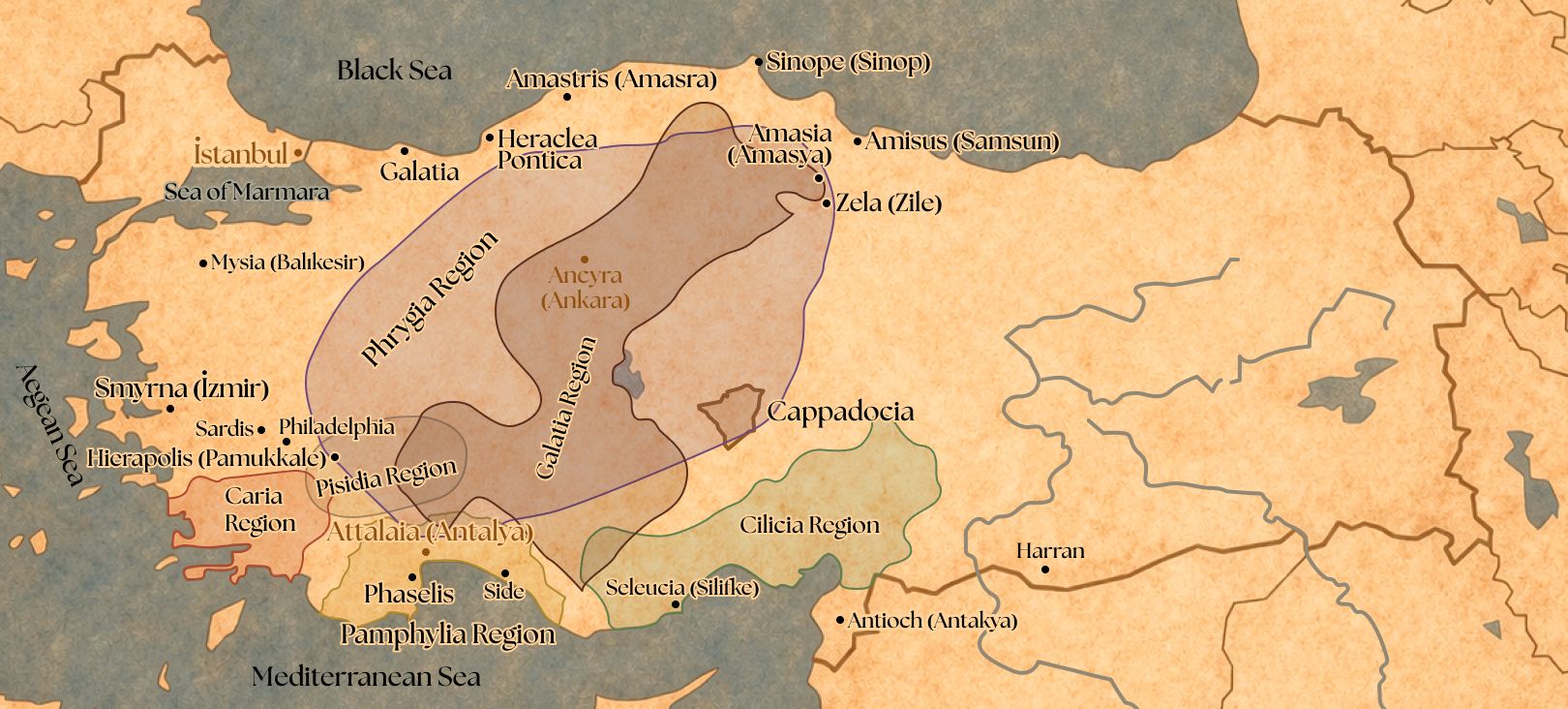
Other Biblical References
Only renowned locations; not an exhaustive map.
Only renowned locations; not an exhaustive map.
Other Biblical References
Hierapolis (Pamukkale)
Christianity came to Hierapolis via Epaphras (Colossians 4:12–13).
Haran (Harran)
Someplace in Mesopotamia, since mentioned along with Gozan and Haran, probably close to them.
Acts 7:2, 4
Ancyra (Ankara)
1 Peter 1:1 (as capital of Galatia)
Caria (Southwest corner of Asia Minor)
1 Maccabees 15:23
Romands sent a circular letter to Caria in 139 BC forbading attack on Jews and recognizing their right to observe Sabbath and customs.
Miletus
Acts 20:15; Timothy 4:20
Philadelphia (Alaşehir, Manisa)
Ingatius: Philadelphians Introduction; Martyrdom of Polycarp 19.1

 Click to Enlarge