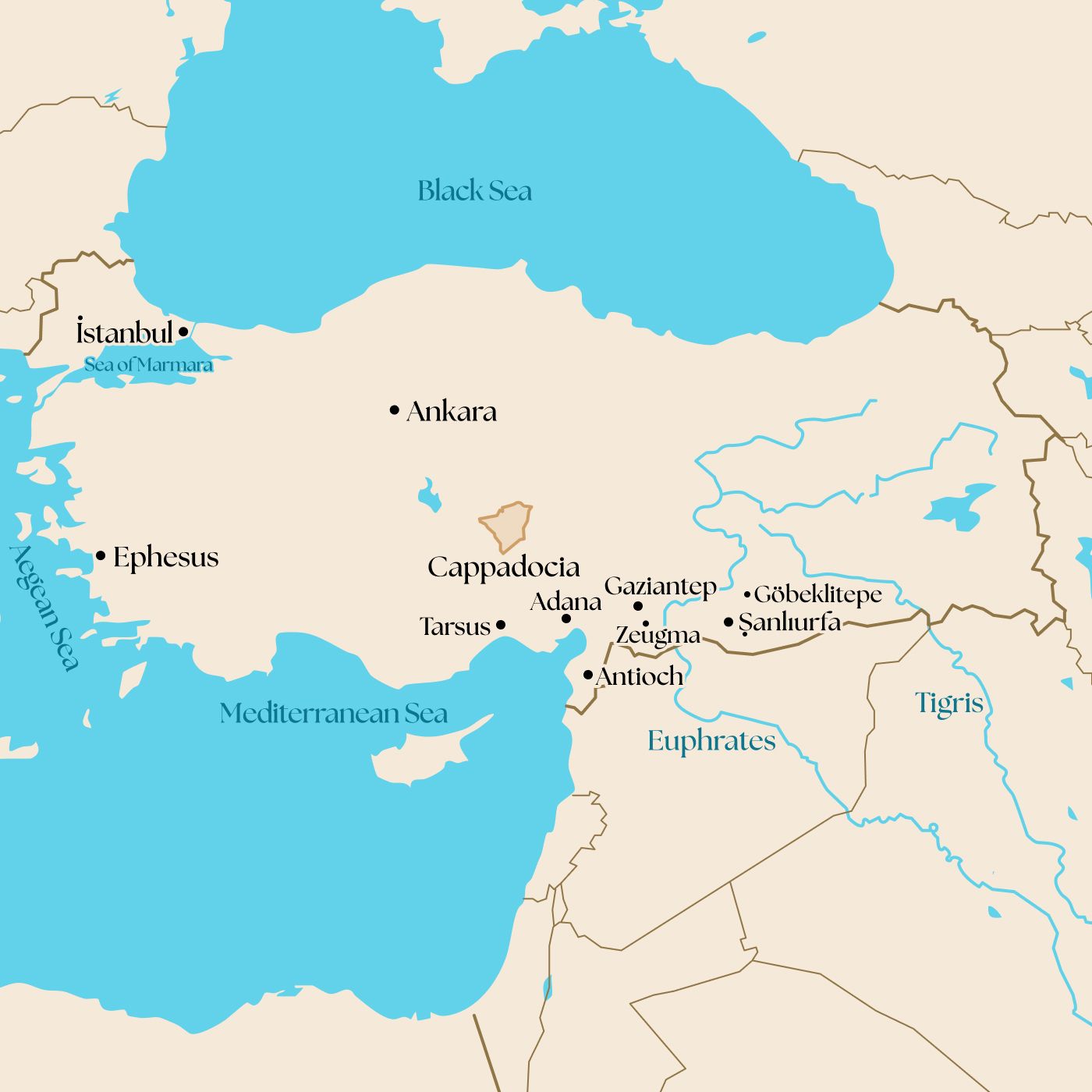
Tour starts in biblical Antoich, follows the tip of the Fertile Crescent and ends in Şanlıurfa in Mesopotamia. With two cities in UNESCO Creative Cities of Gastronomy and unique historical heritage, this itinerary is ideal for both culture aficianados and gourmets.
This area boasts hundreds of recorded recipies, and 200 of them have Geographical Indication and Protected Designation of Origin status.
It is a chance to enjoy an early foodie heritage: cradle of wheat and agriculture, junction of where Levantine and Asia Minor cuisenes meet, still a living Silk Road kitchen. The region is a direct continuity from the stone age hearths of Göbekli Tepe to modern kitchens — a 12,000-year-old story still alive in spice markets and family recipes.
Highlights
- St. Paul’s Well
- Biblical Antioch, UNESCO Creative City of Gastronomy
- Church of St. Peter in Antioch
- Gaziantep, UNESCO Creative City of Gastronomy
- Baklava workshop
- Göbeklitepe Archaeological Site
- Abraham’s Pool
Itinerary Details
Day 1: Welcome to the Fertile Crescent
Arrive at Adana Airport. Meet your guide and driver. Before heading to Antioch, visit Tarsus, hometown of St. Paul, and see the water well that is located in the home he is believed to have been born and lived.
Antioch is home of an extraordinary culinary heritage, thanks to the centuries of exchange created with its Mediterranean Coast, the hospitable Gulf, and location on the Silk Road.
In this city, home to more than fifty food items with Geographical Indication and Protected Designation of Origin status, you will taste the most iconic dishes while sightseeing: the Church of St. Peter — claimed to be one of the world’s oldest Christian churches and a UNESCO World Heritage Site nominee; the 7th-century Habib-i Neccar Mosque — the first mosque in Asia Minor and a symbol of centuries-old coexistence of faiths; and Kurşunlu Han, an Ottoman inn that once hosted merchants and travelers from distant lands along the Silk Road. Call it a day with a stroll by the Asi River.
Sleep in Antioch, 1 night.
Walking: 5 miles. Easy to moderate.
Day 2: Gaziantep, Culinary Capital of Turkey
After a short drive, you will arrive in Gaziantep, the bud for the pistachio industry and home of proud natives. A city with rich history dating back over 5,000 years, and a stop on the Silk Road, is center of baklava industry where you won’t walk a block without seeing a baklava shop. Fluffy Gaziantep baklava filled with pistachios and embraced by honey is protected by the EU as an authentic food.
Here, food is more than an item sustaining life but a social and cultural amalgam. You will visit the Zeugma Mosaic Museum to see breathtaking Roman Mosaics, Emine Göğüş Culinary Museum dedicated to art of cuisine, walk through and stroll the old bazaar quarter and Almacı Bazaar labyrinth of copper workshops, spice merchants, baklava masters mixing with the scent of pistachios, red peppers and sumac. Finally, you will participate in a baklava workshop and see masters layer paper-thin phyllo with local pistachios.
Sleep in Antioch, 1 night.
Walking: 5 miles. Moderate.
Day 3: Şanlıurfa, City of Prophets and Sacred Flavors
Known as the city of prophets and birthplace of Abraham, history, faith and flavor blend in the warm air of Mesopotamia in perennial Şanlıurfa.
Before arriving in the city center, you will start our day with a visit in Gobeklitepe—12,000 year old temple predating Stonehenge and rewrote the history we know of with its discovery. Once in the city, you will visit Balıklıgöl — sacred pool of Abraham where he was claimed to have cast into fire, and the cave where it was beleieved he was born. Strolling through the Urfa Bazaar, a maze full of workshops, spice stalls, you will smell the aroma of rostaed eggplants, peppers and lamb filling the air.
Sleep in Şanlıurfa, 1 night.
Walking: 5 miles. Moderate.
Day 4: Farewell to Mesopotamia
After a hearty breakfast, we transfer you to Şanlıurfa Airport for your onward journey.
What’s included
- All meals and food tasting
- A certified SRM guide
- Private chauffeured vehicle
- Tolls, bridges and parking
- Accommodations in selected hotels
- Admissions
- Fast-track
IN THE KITCHEN
Ancient ingredients still in use are:
- Einkorn (siyez) and emmer (karakılçık/dinkel) wheat: descendants of the world’s first domesticated grains
- Barley (arpa): used for bulgur, beer, and bread.
- Lentil (mercimek): one of the earlies domesticated legumes
- Chickpeas (nohut): cultivated since the late stone age, staple in soups and stews
- Pistachios (antep fıstığı): used in desserts, pastries and pilafs.
- Mulberries (dut): used in syrups, liquers, and desserts
- Pomegranate (nar): domesticated locally, used for molasses, sauces, salads and beverages. Legacy of ancient preservation methods.
- Isot pepper (Urfa biberi): sun-dried and fermented.
- Sumac (sumak): dried berries of a native shrub, a tangy seasoning in salads and kebabs
- Sesame, used for tahini and local oils.
- Wild thyme (zahter): used in salads, breads and meat dishes.
- Coriander (kişniş): indegiounus plant, used in stews, kebabs and spice blends.
- Cumin (kimyon): Used in kebabs, soups and pilafs
- Sesame (susam): used for tahini, breads and pastries.
- Myrtle (hambeles / mersin): aromatic fruit of a native shrub, used in liqueurs and flavoring traditional dishes.
- Olive oil (zeytin) from Roman-era groves.
- Pomegranate molasses (nar ekşisi), a legacy of ancient preservation methods.
Some signature dishes of this geography
Soups, starters, side dishes
Beyran Çorbası (Beyran Soup) – Spicy lamb and rice soup traditionally eaten for breakfast, flavored with garlic, butter, and red pepper.
Mahluta Çorbası (Mahluta Soup) – Lamb, chickpeas, bulgur, tomatoes, and spices slow-cooked into a hearty soup.
Aya Köfteli Çorba (Soup with Small Meatballs) – Delicate tiny meatballs in a seasoned broth.
Tutmaç Mercimekli (Lentil Tutmaç Soup) – Lentil soup with wheat dumplings or small meat parcels.
Yuvalama (Yuvalama Soup) – Tiny meatballs with yogurt and chickpeas.
Ayak Köftesi (Small Meatball Soup) – Tiny meatballs in a seasoned broth, typical starter.
Çiğ Köfte (Raw-stake tartar/Spiced Bulgur Patties) – Traditionally raw meat replaced by bulgur, chili, and pomegranate molasses.
Lahmacun (Thin Meat Pizza) – Thin flatbread topped with minced lamb, tomatoes, parsley, and spices.
Keşkül Pilavı (Keşkül Rice Pilaf) – Rice pilaf with butter, nuts, and subtle spices.
Keşmir Pilavı (Keşmir Rice Pilaf) – Fragrant rice with nuts and raisins.
Bulgur Pilavı (Bulgur Pilaf) – Traditional coarse wheat pilaf served with meats.
Kebabs, main courses
Kağıt Kebabı (Parchment Kebab) – Lamb or beef slow-cooked with vegetables in parchment paper.
Tuzlu Yoğurt Kavurması (Sautéed Meat with Salty Yogurt) – Meat cooked with thickened yogurt and spices.
Belen Tava (Belen Tray Bake) – Oven-baked minced meat, peppers, and onions.
Kınnep Kebab (Kınnep Kebab) – Minced meat and bulgur kebab, charcoal-grilled.
Alinazik Kebabı (Alinazik Kebab) – Smoked eggplant purée topped with spiced grilled lamb.
Küşleme (Lamb Küşleme) – Premium lamb, grilled simply to highlight its tenderness.
Kaburga Kebabı (Lamb Rib Kebab) – Slow-cooked lamb ribs, tender and flavorful.
Şırıl Mavi (Shırıl Mavi Lamb Dish) – Lamb with herbs and rice, served at special occasions.
Muhattemi (Muhattemi Meat Dish) – Slow-cooked minced lamb with bulgur and spices.
İçli Köfte / Oruk (Stuffed Bulgur Shells / Kibbeh) – Bulgur shells stuffed with spiced meat, fried or raw.
Pirinç Oruğu (Rice Oruk) – Rice-filled variation of oruk.
Yılanbalığı Dolması (Stuffed Eel) – Eel with rice, herbs, and spices.
Kaytaz Böreği (Kaytaz Pastry) – Thin dough layers filled with meat or cheese, rolled and baked.
Desserts
Şıllık (Şıllık Pastry) – Thin pastry rolled with pistachio and clotted cream.
Baklava (Gaziantep Baklava) – Layers of phyllo dough, Antep pistachios, and sugar syrup.
Katmer (Pistachio Dessert Crepe) – Sweet pastry filled with clotted cream and Antep pistachios.
Fıstıklı Sarma (Pistachio Rolls) – Rolled phyllo desserts filled with pistachio paste.
Coffees and beverages
Mırra (Bitter Coffee) – Extremely strong, traditional coffee served in small cups.
Antep Coffee (Turkish Coffee with Pistachio Flavor) – Rich, aromatic coffee, lightly garnished with crushed pistachios.
Menengiç Coffee (Terebinth Coffee) – made with roasted and ground seeds of wild pistachio, caffeine-free
Fulya Şerbeti (Fulya Syrup Drink) – Rosewater and herb syrup served chilled.
Fulya Likörü (Fulya Liqueur) – Sweet, aromatic herbal liqueur.
Hambeles Likörü (Myrtle Liqueur) – Myrtle-based, slightly herbal liqueur.
Dut Likörü (Mulberry Liqueur) – Sweet liqueur from mulberries.
 Click to Enlarge