As Athens declined in power through costly wars with Sparta and other neighboring states, the Macedonians to the north swept in. Their leader was young Alexander, son of Philip the Macedonian, and a former student of Aristotle.
Alexander was only 16 years old when he had the power to rule in Philip's name in his absence. He was saying: “My father will get ahead of me and will leave nothing great for me to do”. He went to bed each night with two things under his pillow: a dagger, and a copy of the Iliad.
Alexander ascended to the throne after the murder of his father. As he conquered Greece, he turned his face to the East. And in the spring of 334 BC, he crossed the Dardanelles with over 30,000 spears.
His victory against the Persians in Issus sealed Macedonian rule throughout Asia Minor. Alexander went into Darius's tent after the battle, and looking at the luxury, said: “So this is what it means to be a King!”
Tour Highlights
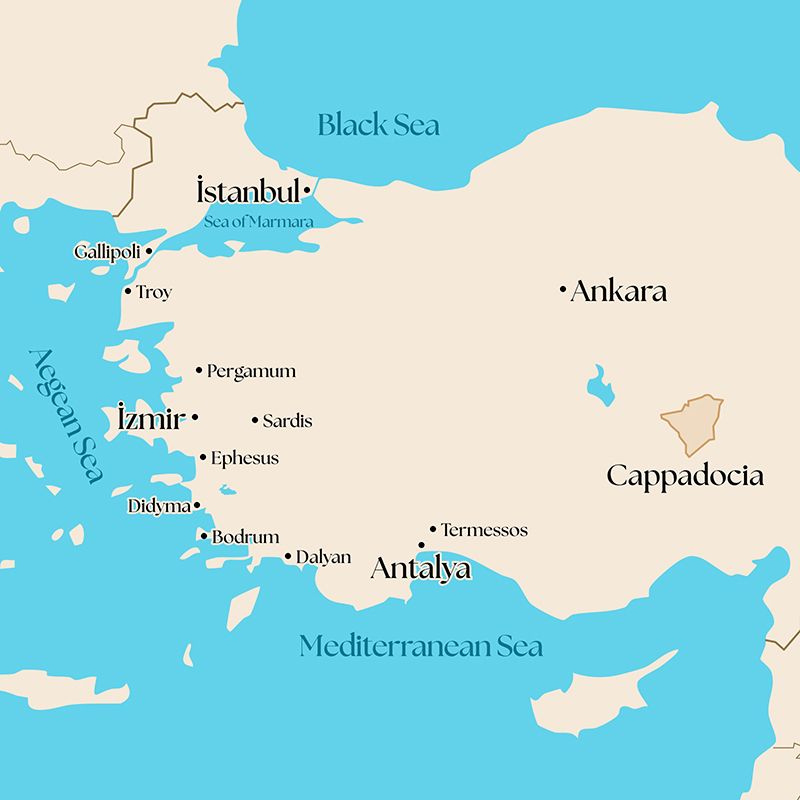
- Highlights of Byzantine and Ottoman Istanbul
- Legendary Troy, and Gallipoli peninsula WW1 battlefields and memorials
- Hellenistic Pergamon, the acropolis that once rivaled Athens itself
- Asclepion, ancient medical center dedicated to Apollo
- Ancient Ephesus, capital city of the Asian Province of Rome
- The Temple of Apollo in Didyma
- Bodrum Castle, and the Museum of Underwater Archaeology
- Gordion, where Alexander cut the knot tied by King Gordius
- Cappadocia; unusual landscape and amazing rock formations
Itinerary Details
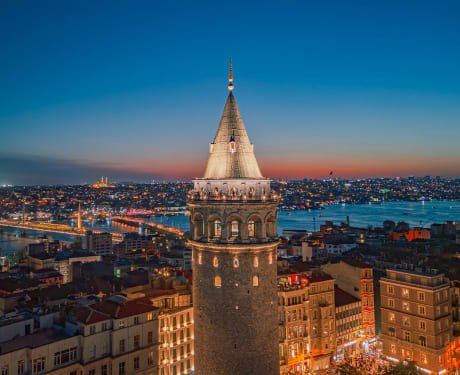
Day 1: Istanbul
Welcome get together. Dinner will follow the tour introduction.
Day 2: Istanbul
Start the day with the Museum of Archaeology where we see the sarcophagus of Alexander the Great. The sarcophagus was brought here from the royal necropolis of Sidon.
Then, continue to Topkapi Palace, the administrative center for the Ottoman dynasty for over 400 years. Tour includes the Harem, private apartments of the Sultans.
Hagia Sophia was the pride of the Byzantine capital city. The unique architectural style influenced many generations to come.
The Blue Mosque is renowned for its elaborate architecture, and the blue and white tiles that decorate the interior.
Orientation and free time in the Grand Bazaar.
Day 3: Mt. Ida
Drive to Gallipoli to visit WWI memorials, and to walk on the soil that once witnessed the end of an era. Then we cross the Dardanelles.
Quest for the battlefield on the River Granicus: The Persian plan was to tempt Alexander to cross the river, and to bring an end to Macedonian advance right there. They almost succeeded, but the Persian lines could not resist for too long. The victory opened up the gates of Asia Minor to Alexander.
As you go to Troy, you might as well hear Alexander say; “O fortunate youth, to have found Homer as the herald of your glory!” as he paid his respect to Achilles and Ajax.
Then, continue to Mt. Ida. This is where Zeus watched the war over Helen of Troy.
Day 4: Şirince
Drive to Pergamon. The ruins of this spectacular Acropolis are a thousand feet above the contemporary town, and commands an extraordinary view in all directions. The city owes its prosperity to Lysimachus, general of Alexander. Besides the acropolis, we will visit Aesclepion, ancient medical center dedicated to Apollo.
Later in the day, we drive to Sardis, capital city of ancient Lydia. The phrase “rich as Croesus” refers to the legendary king of this state. This is where minted coins – as a monetary unit - ultimately changed the long-lasting way of commercial life; exchange of goods!Day 5: Şirince
Day 5: Şirince
Today you’ll be walking the marble streets of ancient Ephesus. We will also visit the local Museum of Archaeology to see the rare findings from the site. The Temple of Artemis in Ephesus is one of the seven wonders of the ancient world. In BC.356, a man named Herostratus burned the temple to the ground to immortalize his name. The legend says that Alexander was born the very same night! And the temple burned down, as the Goddess left her temple unprotected to help Alexander’s mother who was in labor.
Day 6: Bodrum
Drive to Bodrum, the birthplace of Herodotus. En route, we will visit Didyma to see one of the best-preserved Hellenistic temples that survived to our day; the Temple of Apollo. The temple was one of the major oracle centers in the past, and rivaled Delphi. This is also where the prophecy of Alexander's ultimate victory over the Persians came from.
In the ancient city of Priene, you will observe clever city planning techniques put into practice. Another site you will visit today is Miletus, hometown of Thales, renowned philosopher, scientist and mathematician.
Day 7: Bodrum
The Castle of St. Peter was built in early 1400s as a crusader stronghold. Today, it houses the Bodrum Museum of Underwater Archaeology, one of the best museums of its kind, an exciting setting, and an outstanding exhibition of artifacts, as a result of thousands of dives. Later in the day we’ll visit the ruins of the Mausoleum of Halicarnassus, one of the wonders of the ancient world.
Day 8: Antalya
Perched high on a mountain north of Antalya, ancient Termessos looks like an eagle's nest. This is one of the few cities that could put up resistance to Alexander's military might and eventually got away with it. Drive over the Taurus Mountains to Antalya.
Day 9: Antalya
According to the legend, ancient Phaselis was where the spear of Achilleus was kept. It was here that Alexander was crowned with a golden wreath. Phaselis had a great location, and well-protected harbors, but Alexander chose another city, Perge as the regional base. The ruins of this once glorious city are in a perfect state of preservation.
The Museum of Archaeology in Antalya has one of the finest collections of ancient sculptures. This is where we end the tour for the day.
Day 10: Ankara
Gordion knot... oracle stated that who untied the knot would rule Asia Minor. And Alexander cut the knot with his sword. Gordion was the capital of Phrygia. This is where we will see the tumulus, in other words the last resting place of King Midas. Then you will head for Ankara, capital city of modern Turkey.
Day 11: Cappadocia
After a brief orientation in Ankara, drive to the ancient citadel for the Museum of Anatolian Civilizations - a great introduction to Anatolian cultures, from prehistoric times to the Roman Empire. We take a stroll to see the district known as the inner citadel before we leave for Cappadocia.
En route, we will visit a 13th century Caravanserai that served through the centuries as an inn for merchants and travelers on the Silk Road.
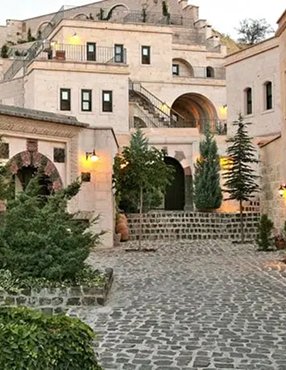
As we arrive in Cappadocia, we will take a walk to get to know the area we will be staying for the next couple of nights.
Day 12: Cappadocia
An unusual landscape and amazing rock formations — but as you will discover there is more to it. Here in Cappadocia, you will get together with locals on occasion and have a chance to listen to their side of the story.
Today we visit Göreme Open Air Museum, on the Unesco World Heritage list, to see the late Byzantine churches carved in the rock. Then we drive to the underground city of Kaymakli that was once a temporary shelter in times of danger and siege.
Day 13: Istanbul
We fly back to Istanbul. After an orientation in the Spice Market and the surrounding neighborhoods, we take a cruise up the Bosphorus, the strait that divides the two continents. The day will end with our farewell dinner.
Day 14:
Tour is over after breakfast.
What’s included
- A certified SRM guide
- Private chauffeured vehicle
- Tolls, bridges, and parking
- One domestic flight: Kayseri to Istanbul
- Accommodations in selected hotels
- Lunches
- Admissions
- Fast-track
 Click to Enlarge