This journey along Turkey’s western shores traces one of the most storied landscapes on earth — a crossroads where faith, trade, and art first intertwined. We walk through the marble streets of Ephesus, where early Christianity took root, and stand amid the columns of Sardis, once the seat of kings and one of the Seven Churches of Revelation. Yet between these monumental places lies the quieter heart of the Aegean — villages where life continues with graceful constancy. In the hills above Bodrum, families still weave rugs on ancestral looms; in the olive groves near Urla, farmers gather the “immortal fruit” by hand as their forebears did. Vineyards, workshops, and whitewashed courtyards reveal a rhythm that outlasts empires. This is not only a journey through ruins but through living memory — discovering how the sacred and the ordinary, the ancient and the present, still share the same sun and sea.
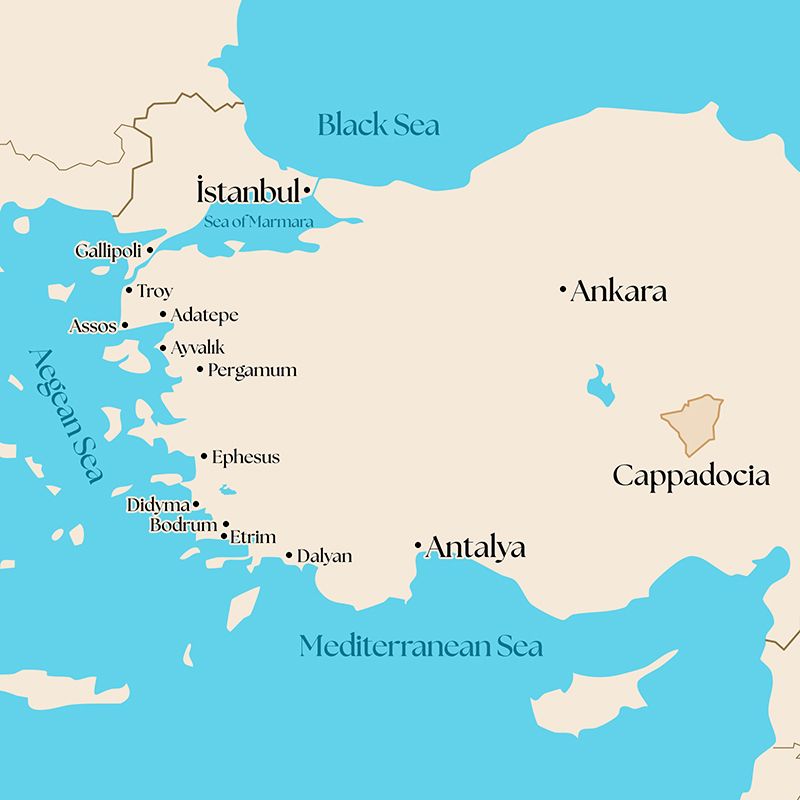
Starts in Istanbul; ends in Bodrum
Tour Highlights
- Thracian wine country, a major step in the spread of grapes into Europe
- Gallipoli Peninsula and WWI memorials, where national identities were forged
- Troy and Schliemann’s Trench, the site of Homer’s epic, The Iliad
- Off-the-beaten-path, picture-perfect small villages—in the mountains and along the coastline
- Gourmet tasting experiences and local delicacies
- Immersion in the culture
- Ephesus, the most complete ancient Roman city anywhere
- Traditional handcrafts and craftspeople who have not given in into mass production
Itinerary Details
Day 1: Wine Country
Starting in Istanbul this morning, drive west through the vineyards of Thrace. The morning stop will be the picture-perfect village of Uçmakdere, tucked in the Ganos Mountains, high in a river valley with sweeping sea views. With its cobblestone streets and unique architecture, it was once home to some 30 vineyards that proudly exported their wines across the Mediterranean. After a stroll in the village, you will enjoy the village teahouse and sip tea from tulip-shaped glasses. Then continue to Eceabat to visit the Wine History Museum, where you will trace the epic 9,000-year journey of the grape — from its wild origins in the South Caucasus Mountains to Asia Minor, where it was first domesticated, cultivated, and shared with the world.
Sleep in Eceabat, 2 nights.
Walking: Light
Day 2: Gallipoli
The day is dedicated to the Gallipoli Peninsula, the site of the famous WWI battle. With profound importance for Turks and ANZACs (Australian and New Zealand Army Corps), it is a site remembered by all three nations with mutual respect. It marked the birth of national consciousness and identity for all three nations, and the emergence of a junior Turkish officer – who later was named “Ataturk” and became modern Turkey’s founding father. In honor of all lives lost in Gallipoli, Atatürk said:
"Those heroes that shed their blood and lost their lives… You are now lying in the soil of a friendly country. Therefore, rest in peace. There is no difference between the Johnnies and the Mehmets to us where they lie side by side here in this country of ours… You, the mothers, who sent their sons from far away countries, wipe away your tears; your sons are now lying in our bosom and are in peace. After having lost their lives on this land they have become our sons as well."
Walking: Strenuous
Day 3: Troy and Legends
Start the day by ferrying from Europe to Asia across the Dardanelles and arrive at the ruins of ancient Troy — the mythical site of Homer's Iliad, Helen of Troy, and the Wooden Horse. Beyond mythology, our tour will reveal the many layers of history that exist beneath our feet. Continue with a visit to the award-winning Troy Museum. Then drive to the village of Behramkale and wander along the cobbled streets. After enjoying sweeping views from the Temple of Athena in the ancient city of Assos—a watchtower overlooking the Aegean 2,500 years ago, where Aristotle once taught and where Saints Paul and Luke met — continue to Adatepe Village on legendary Mt. Ida, nestled among pine forests.
Sleep in Adatepe village on Mt. Ida, 2 nights.
Walking: Strenuous
Day 4: Mountain Village Life and Olive, the Immortal Fruit
This day is devoted to the culinary delicacies of the area, and tasting cheeses made with the milk of free-grazing dairy animals feeding on wild oregano and thyme. At the Olive Oil Museum, you will learn the story of this eternal fruit (if tour date corresponds to olive harvest, you may join locals in the orchards). In the afternoon, enjoy a village walk, visit Altar of Zeus, awe at the view of the Aegean Sea and island of Lesbos, and spend time with villagers in the tea garden.
Walking: Moderate
* If your travel dates are in late fall or early winter, experience hands-on olive harvesting, actually pick olives by hand and see how traditional cold-press olive oil is made. Turkey ranks among the top five olive oil producers in the world, and the Aegean region is right at the heart of it all. The area is known for producing exceptionally high-quality olive oil, the result of its mountains, valleys, cool breezes, sunshine, and just the right amount of rain.
The olive tree itself, long considered a symbol of peace, wisdom, and fertility, dating all the way back to Greek mythology (it was a gift from Athena, after all). These trees live long lives—300 to 400 years on average, with many over a thousand years old. It’s no surprise they’re often called “the immortal tree.”
Day 5: Ayvalik, the Devil’s Peak, and Seafood
A scenic drive down to the coast will take you to the fishing town of Ayvalık. Enjoy an orientation walk through the cobblestoned alleys of this once-prosperous town — which once minted its own gold coins — then drive to breezy Devil’s Peak for sweeping views of the archipelago and Cunda Island, the seafood capital of Turkey.
Sleep in Ayvalık, 1 night.
Walking: Moderate
Day 6: Pine Nuts and Acropolis of Pergamum
On the way south, drive through the high pastures of Kozak Plateau, the pine-nut capital of the world. We will visit a farming village and meet locals while sipping the region’s signature tea, where pine nuts float playfully. Then, take the cable car up to the ancient city of Pergamum.
Perched high atop its Acropolis, Pergamum's ancient theater and the Temple of Trajan are among the most beautifully situated ruins in the world. Here also stood the Altar of Zeus, often regarded as the Eighth Wonder of the Ancient World. Continue south, sleep in Kuşadası, 2 nights.
Walking: Strenuous
Day 7: Ephesus
The travel thrill today is the tour of the ancient city of Ephesus, one of the wealthiest cities in ancient Greece. It also played a role in the formation of the early Christian Church, drawing the attention of the Apostle Paul. You will take an extensive walking tour along the still-paved streets and remarkable ruins of Ephesus, including the dramatically restored façade of its Library of Celsus.
Walking: Strenuous
Day 8: Nature Hike and Prehistory
Heading south, you will drive by the craggy Latmos Mountains and Bafa Lake — now a nature preserve, once a bay of the Aegean Sea, later landlocked by silt carried by the Meander River. When it was cut off from the sea and transportation became difficult, the rugged lakeside city of ancient Herakleia became the hideout of early Christians and monks.
Walking through and from the rural Kapikiri village, you will see prehistoric wall paintings dating back to 6500 BCE. Distinctly different from other prehistoric wall paintings, these display an emphasis on family rather than individual figures or hunting scenes, families with children, and the depiction of the world’s first wedding are among the 170 identified so far.
Continuing to Bodrum, on the way visit the remarkable Temple of Apollo, one of the most complete standing marble temples of the Hellenistic period.
Walking: Strenuous
Day 9: A Day in the Village
Spend the day in the beautiful village of Etrim, tucked away in the hills not far from Bodrum. This village is a living example of how passion and perseverance can help a village thrive without giving in to the pull of big-city migration. Instead of leaving, families here have stayed and protected their heritage, and in doing so, built a life that’s both satisfying and deeply rooted in tradition.
Weaving here is not just a craft but a way of life, passed down for generations. We’ll be welcomed by a local artisan whose family has been weaving here for over 500 years—yes, really! They’ll open their home, and you will get a firsthand look at what life is like in the village: the looms, the colors, the stories woven into each rug.
To top it off, sit down to enjoy a homemade lunch with the family—simple, local, and always heartfelt.
Walking: Light
Day 10: Seven Wonders of the Ancient World
This morning you will explore Bodrum's harbor-side Castle of St. Peter. Built by crusader knights who were adept at recycling bits of Greek and Roman temples, the castle today is home to the Museum of Underwater Archaeology. You'll tour its outstanding collection of artifacts reclaimed from the sea, including a reconstructed sunken Roman ship. In the afternoon you'll wander to another wonder of the ancient world, touring the Mausoleum of Halicarnassus.
Walking: Moderate
Day 11: Tour Over After breakfast
After breakfast, your driver will transfer you to Bodrum Airport for your onward journey.
What’s included
- A certified SRM guide
- Private chauffeured vehicle
- Tolls, bridges, and parking
- Accommodations in selected hotels
- Lunches
- Admissions
- Fast-track
 Click to Enlarge