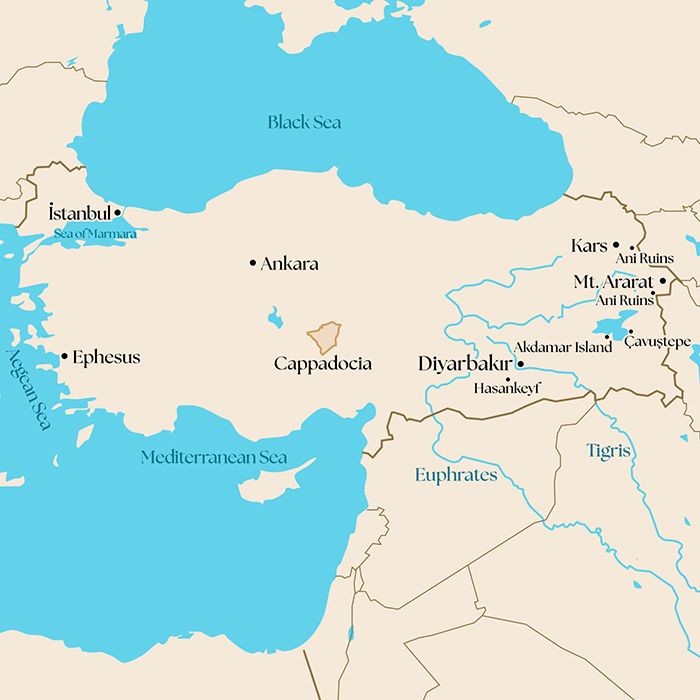
Discovery of Eastern Turkey, from the banks of the Tigris River to the shadow of Mt. Ararat and beyond—through the fortresses of ancient Urartu, the sacred island of Akdamar, by way of the feudal stronghold of İshakpaşa Palace and onward to the medieval Armenian capital, Ani.
- Starts in Diyarbakır, ends in Kars.
- Tour can be re-designed to your specifications, travel plans and expectations.
Tour Highlights
- Hasankayf on the Tigris, that once controlled the trade route along the river
- Walls of Diyarbakır
- City of Van, home to mighty Urartian kings
- Ishakpasa Palace by Mt. Ararat
- Ancient Ani on the Armenian border
Itinerary Details
Day 1: Arrival in Diyarbakir
Meet your guide, driver and private vehicle at the Diyarbakır Airport and drive to the city. As you walk the narrow streets of old Diyarbakir, you will observe a unique harmony of cultures, styles, and architecture. Visit the impressive UNESCO-listed basalt walls that once protected the city, considered the longest, most intact set of defensive walls in the world after the Great Wall of China. Enjoy the view from the Keçi Burcu (Goat Bastion), look down onto the lush Hevsel Gardens along the Tigris River, a fertile plain that sustained the city for millennia.
In Sur—the historic quarter of the city— walk the maze of narrow streets, see the traditional stone houses, and centuries-old monuments reflecting Armenian, Syriac, Islamic, and Ottoman heritage.
Walk will include the Great Mosque (Ulu Cami), one of Anatolia’s oldest which was modeled after the Umayyad Mosque in Damascus, and the iconic Dört Ayaklı Minare (Four-Legged Minaret)—follow the local tradition and pass between the pillars brings for good fortune. Before calling it a day, visit the 16th century Hasan Paşa caravanserai and sample Diyarbakır’s famed coffee (menengiç or traditional Turkish).
Sleep in Diyarbakır, 2 nights.
Walking: 2-3 miles. Moderate on basalt cobblestones, uneven alleys and flat courtyards.
Day 2: Hasankeyf, Mesopotamia and the Ethnic Heritage
Your day is dedicated to fertile lands of Upper Mesopotamia, which was sought after by empires for its strategic position and agricultural wealth. For millennia, the valleys of the Tigris River connected Anatolia to Mesopotamia (central and eastern Turkey), serving as a corridor for trade, armies, ideas and fairy tales.
In Hasankeyf, you will see the monuments still conveying its grandeur: the medieval citadel perched high on a cliff, the ruins of the Artuqid bridge (once among the largest of its time), and scattered mosques, caves, and tombs. Standing on the Tigris banks, you witness both the endurance and fragility of heritage in Mesopotamia.
Back in Diyarbakır, you will explore its ethnic and cultural heritage, the still active 3rd century Virgin Mary Syriac Church and the recently restored Surp Giragos Armenian Church, the largest in Mesopotamia.
Sleep in Diyarbakır.
Walking: 2-3 miles. Light to moderate, mostly on historic and uneven surfaces.
Day 3: Lake Van and Church of the Holy Cross
Today’s drive is more than just a transit, you will witness the dramatic change of the landscape, from the plains of Mesopotamia to the volcanic highlands of ancient Urartia, and finally to the blue sparkle of Lake Van—Turkey’s largest lake. Near Silvan, stop for a tea break and visit the 12th-century Malabadi Bridge on the Batman River, one of the largest medieval stone arches in the world and in a good state of preservation. At the shores of Lake Van, you will be 1,640 meters above sea level and you will board a boat to reach Akdamar Island. Here, you will sightsee the Church of the Holy Cross—UNESCO Tentative List— a 10th century church which was once the seat of the Chief Bishop of the Armenian church. The church was built out of pink volcanic stone and stands out with the extraordinary exterior reliefs. This was the very first time such elaborate sculpted imagery appeared on the exterior of a church, a timemark in Christian art and architecture.
Sleep in Van, 2 nights.
Walking: 2-3 miles. Moderate on historic stone paving, gravel and dirt paths.
Day 4: Castles and Cats of the Land of Urartia
Van is a living textbook example of the history of eastern Turkey, countless civilizations have called the city home. Today, you will meander between eras and civilizations and visit three different castles. Çavuştepe from the 8th century, an Urartian stronghold where you will walk among terraces, defensive walls, gates and towers. You will see temples and storage jars revealing the scale of Urartian agriculture and surplus. In Hoşap, you will step into the 17th century and visit an Ottoman-Kurdish frontier fortress perched high above the valley, commanding the surrounding geography. And, in the Van Castle at Tuşpa—the Urartian capital— where you will witness marks of different civilizations carved into stone, including the cuneiform inscription by Xerxes. Before calling it a day, visit the Van Cat House, and learn about the unique local breed famous for their snow-white fur, odd-colored eyes, and their unusual love of swimming!
Sleep in Van.
Walking: 2-3 miles. Moderate on historic surfaces, short uphill sections at Hoşap and Van Castles which may be more difficult due to sloping.
Day 5: Fairy-tale Palace and Mt. Ararat
On this fascinating route, you will drive parallel to the borders of three different countries in one day, Iran, Azerbaijan and Armenia on the highest plains of Eastern Anatolia. With landscape as your travel companion, you will drive among volcanic mountains, high plateaus, deep valleys and rivers. Near Doğubayazıt, you will visit the remarkable 17th-century Ishak Paşa Palace. Truly eclectic and unique, it combines Ottoman, Persian, Armenian, and Georgian influences marking its position as a crossroads stronghold. With gates, courtyards, tombs, women’s (harem) and men’s quarters, it feels as if the tales of the 1001 were written for it. While driving past Mt. Ararat, you will stop to photograph the two peaks of Mt. Ararat—greater and lesser Ararat— and the meteor crater, claimed to be the second largest.
Sleep in Kars, 2 nights.
Walking: 2 miles. Light, on stone courtyards, historic rooms. Short walk on dirt or gravel.
Day 6: Kars and Ani
Start your day with a famous Kars breakfast: organic honey from nearby highlands, regional cheeses (including the distinctive kaşar and gruyere), jams, olives, and rural specialties.
After breakfast, leave for Ani, once the magnificent capital of medieval Armenia, known as the “City of 1,001 Churches”. You will explore several of the monuments still standing today, including the Cathedral, Church of St. Gregory, Manuchihr mosque built by the Seljuks and the impressive double city walls that guarded this prized Silk Road hub.
In the afternoon, visit the 19th-century Russian quarter in Kars, take a stroll along the riverside admiring the old stone bridges. There will be a chance to climb the dominating Kars Castle for a panoramic view.
Sleep in Kars.
Walking: 3 - 4 miles. Moderate on grassy, dirt, uneven surfaces in Ani, cobblestones in Kars.
Day 7: Tour ends
After a delicious Kars breakfast, transfer to the airport or move on to your next destination.
What’s included
- A certified SRM guide
- Private chauffeured vehicle
- Tolls, bridges and parking
- Accommodations in chosen hotel/s
- Lunches
- Admissions
- Fast track
You can extend this trip by combining it with
 Click to Enlarge