Southeast Turkey is Upper Mesopotamia. It is the northern tip of the Fertile Crescent.
Here, it all began: the dawn of human history. The birthplace of the earliest cities and agriculture. A launch pad for humanity’s great journey, the Neolithic Revolution.
Civilization was here before the pyramids, before Stonehenge and before Parthenon.
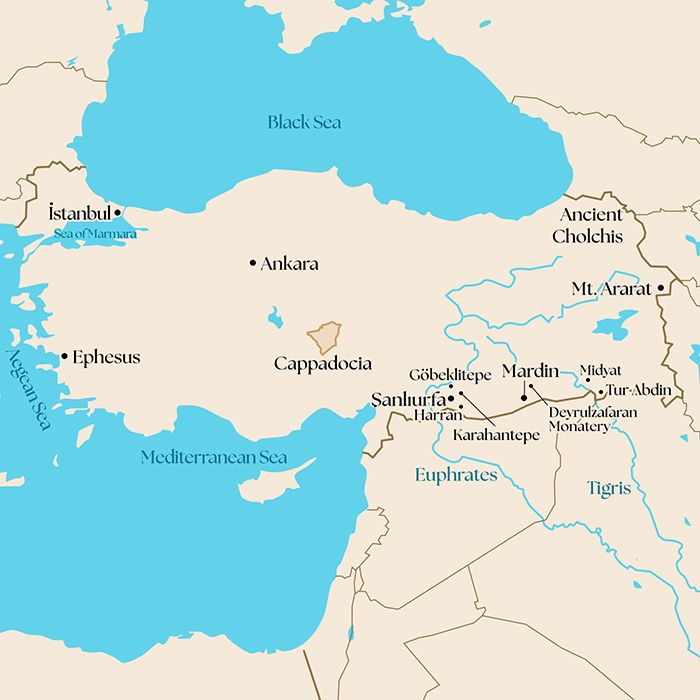
Our mini tour focuses on Göbeklitepe, Karahantepe, and Mardin with Tur Abdin— UNESCO Tentative List—. Destinations which are must-see on any archaeology or history enthusiast’s checklist.
Tour Highlights
- Göbeklitepe & Karahantepe
- Urfa Man
- Historic Urfa Bazaar
- Biblical Harran and beehive homes
- Mesopotamia
- Deyrul Zafaran (a.k.a. Saffron) Monastery
- Syrian Orthodox Monasteries where Aramaic (language of Jesus) are still spoken
- Tour can be re-designed to your specifications, travel plans and expectations.
- You can extend by adding a visit to Mount Nemrut (Nemrut Dağı) as a pre-tour. Or, by combining with the Ararat and Eastern Turkey itinerary.
Itinerary Details
Day 1: Göbekli Tepe - Karahantepe
Meet your guide, driver and private vehicle at the Şanlıufra GAP Airport to begin your journey. As you drive to your first site, your guide will provide an orientation to Taş Tepeler (“Stone Hills”), a cluster of at least twelve late Paleolithic and early Neolithic sites, including Göbekli Tepe and Karahantepe, spread across roughly 200 km².
Groundbreaking, these discoveries have reshaped our understanding of prehistory, challenging the long-standing “hunter-gatherers first, monuments later” sequence.
During your relaxed visits to both Göbekli Tepe and Karahantepe, you will see the T-shaped limestone pillars, monumental enclosures, and striking carvings. In the Şanlıurfa Archaeology Museum, you’ll view Urfa Man—the world’s oldest life-size human sculpture—and other recent finds.
Sleep in Şanlıurfa, 2 nights.
Day 2: Harran - Şanlıurfa
In the morning, drive to Harran, on the Syrian border. The city witnessed the progress of mankind since the beginning of written history. Based onntradition, Harran is where Abraham and his family started on their journey to Canaan. Not only its biblical past, the ruins of the nearby pagan temple, the ancient university complex, and the unique beehive houses are worth the attention.
The afternoon is dedicated to the city itself: they call it the city of prophets; Urfa is one of the prosperous cities of the region with a proud history. You will visit the Pool of the Sacred Carp, see the Dergah and the cave that is believed to be the birthplace of prophet Abraham. The bazaar will take you into the colorful world of textiles, spices, copperware, and many others. And, the bird keeping locals will tell all about their interest in pigeons, and why they are willing to pay a small fortune for a pair.
Day 3: Mardin – Saffron Monastery
Today you travel to Mardin across the plains of Upper Mesopotamia, where stone speaks and the call to prayer mingles with church bells—a honey-colored hill town of abbaras (stone-vaulted passageways), minarets, and Syriac churches. In its stepped streets, Turkish, Arabic, Kurdish, and Syriac mingle as everyday speech, while mosques, monasteries, and churches share the skyline. The crafts and cuisines of its communities keep the Mesopotamian heritage alive. Before arriving in the city, you will visit Deyrulzafaran Monastery (the Saffron Monastery), once the seat of the Syriac Orthodox Patriarchate for over 600 years. The community still speaks Aramaic, language of Jesus. Once in Mardin, you will stroll the Old City to observe the unique stone masonry, including the Zinciriye Madrasah, the Church of the Forty Martyrs—learn about dying art of hand-painted church curtains— and the Great Mosque.
Sleep in Mardin, 2 nights.
Day 4: Mountain of the Servants of God
For a day trip, drive east to Tur Abdin (“the Mountain of the servants of God” in Syriac), a limestone plateau dotted with villages and Syriac Orthodox (Miaphysite, Oriental Orthodox) monasteries. This region —on the UNESCO Tentative List— often called “the Mount Athos of the East”, but —unlike Athos— it is inhabited with villages and monastic roots are four centuries older. You will not only visit the Mor Yuhannon Church, but also taste the local Syriac wine and have lunch in a 400-year-old estate with the resident family. In Midyat, you will see the finest examples of Mesopotamian masonry—honey-colored mansions, church bell towers and mosques— and visit workshops to see the local telkâri (silver filigree).
Day 5: Transfer to airport or next step in Turkish adventure
After a hearty Mesopotamian-style spread with local delicacies including tandır bread, a variety of cheeses, olives, zahter dip (wild thyme blend with olive oil), tahini and grape molasses, honey and kaymak, sembusek (closed flatbread with tomatoes, herbs and minced meat), finishing with a cup of mırra (strong, local coffee), terebinth or cardamom coffee, you will transfer to the airport or continue to your next destination.
What’s included
- A certified SRM guide
- Private chauffeured vehicle
- Tolls, bridges and parking
- Accommodations in chosen hotel/s
- Lunches
- Admissions
- Fast track
Contact us to book and customize.
 Click to Enlarge